Showing posts with label Caplin. Show all posts

Monday, July 9, 2018

New publications: Parts 6 & 7 of the Mozart Form Functions Series

I have published two new essays on Texas Scholar Works. These are the final entries in the series Formal Functions in Menuets by Mozart. Part 6 is subtitled "Contemporaries, 1771-1780"; Part 7 is "Contemporaries and Successors, 1780-1828." Link to Part 6. Link to Part 7.

Here are the abstracts.

Part 6:
This essay continues the documentation of formal functions (after Caplin) in named menuets from the eighteenth century, as begun in parts 1-4 of this series. In this essay, the focus is on menuets written by other composers during the middle decade of Mozart’s life, 1771-1780. The repertoire includes music by Carl and Anton Stamitz, Franz Joseph Haydn, Luigi Boccherini, and several others, as well as menuets in collections or compilations intended for performance, dancing, or pedagogy.

Part 7:
This final essay in the Mozart series charts formal functions (after Caplin) in named menuets written by other composers during the last ten years of Mozart’s life, 1780-1791, and by three composers active in Vienna thereafter, through the death of Schubert (1828). The repertoire includes menuets by Carl and Anton Stamitz, Franz Joseph Haydn, Luigi Boccherini, Giovanni Viotti, and Adalbert Gyrowetz, and several others. The three later composers are Beethoven, Hummel, and Schubert. Concluding comments return to questions of musical form theory.

Thursday, March 15, 2018

Wikipedia article

The Wikipedia article on William Caplin has recently been expanded; it now includes a brief summary of his form function theory and a section with suggestions for "Further reading." Link.

Tuesday, November 28, 2017

New publication: Part 2 of Form Functions in Mozart Menuets

I have just published Formal Functions in Menuets by Mozart, Part 2: Sonatas and Chamber Music on the Texas Scholar Works platform.

Here is the abstract:
Continuation of a study of formal functions (after Caplin) in named menuets by Mozart. A table of data and comprehensive musical examples cover the trios, string quartets, string quintets, quartets and quintets with other instrumentation, piano sonatas, and violin sonatas.
For both parts of the study, the principal results are:
(1) An older historical narrative is discredited, according to which 18th century composers used period themes but Beethoven turned toward sentences instead. The menuet designs are remarkably and consistently varied.
(2) The antecedent + continuation theme is so important to the menuet repertoire that I have named it the “galant theme.”
(3) A small but still significant number of presentation + consequent themes appear.
(4) The available theme categories do not account well for some features of an 8-bar theme’s second phrase. In particular, “continuation” is too broad to account for the difference between “development” (as in fragmentation or sequence) and “continuing melody” (as in a new basic idea).

Tuesday, July 12, 2016

The 4 "C"s: on second phrases

In my PDF essay Dance and Dance Designs in 18th and Early 19th Century Music (link), I came to the following conclusions about first strains after a study of Beethoven menuets and German dances:
(1) the surprising variety of forms -- or, to put this negatively, the "stereotypical" period is by no means the most common type--although the "weak antecedent" [compound basic idea] plus consequent does appear, in fact more often than any other type--nor is the sentence so common as one might expect; 

(2) the large number of hybrid forms; 
 
(3) the weakness of the functional terminology at capturing a strong sense of contrast between bars 1-4 and 5-8 -- it is evident that the label "continuation" is too broad, but it is, on the other hand, difficult to think what might effectively distinguish a "contrasting phrase" from a continuation. Nevertheless, the idea of immediate and sharp contrast between phrases (and strains) is a particular feature of the waltz, one that is related to a similar tendency in later 18th-century menuets and that persists -- as a contrast of strains -- far into the waltz's later history.  (48)
The first of these has been the focus of posts on this blog over the past month or two. The second is obviously a corollary to the first. The third is the point of interest here. (Material in this post comes in part from my online essay Form Functions in Menuets by Beethoven and Others, 1770-1813:
A Contribution to the History of Design for Dance Musics: link.)

With the caveat that I make no claims about other genres than music for social dance, I have expanded terminology for the second phrase in an 8-bar theme from two items to four:

  1. consequent, as in Caplin. This has two subclasses: literal repetition of bars 1-2 as 5-6, and transposed bars 1-2 as 5-6. The transposition is most often by step.
  2. continuation, as in Caplin. This subsumes continuation-cadential and cadential as subclasses (which is in any case the way Caplin treats them: harmonically determined variants of the "classic" continuation phrase). For dance music, the two new classes of complement and contrast effectively reduce continuation to the "Op2n1" case (Caplin's first example for the sentence), where the motive of the opening is repeated but fragmented in bars 5-6. I have discarded continuation-cadential and cadential because they are harmonically determined, where I would claim that melodic features are more expressive and determinative in music for social dance (even in Schubert).
  3. complement. Use "complement" or "complementary phrase." The most common case uses rhythms and/or melodic figures internal to the first phrase.
  4. contrast. Use "contrast" or "contrasting phrase." Figures are pointedly different from anything in the first phrase.
The list assumes a continuum from a strong sense of repetition to a strong sense of contrast or difference. As always, many themes may accept labels easily, others may require interpretation. In the latter case, it is important to preserve the interpretation through comment (as Caplin routinely does), rather than simply apply the label and therefore threaten to conflate the clear and the ambiguous.

The justification for these additions—beyond taxonomic completeness or subtlety—is that dance pieces are miniatures, and qualities that we might give little attention to in the larger-scale environment of a small ternary or sonata movement acquire more importance in the close quarters of a 16 bar menuet or ecossaise. Dances in Mozart's or Schubert's generations were chains of such miniatures, tied together by the continuity of the dance itself, not by some sort of emergent unity of motive, tonality, or expression.

Here, without comment, are "classic" examples of each of the four types listed above.

Consequent (1): Mozart, 12 Menuets, K. 164 (1772), n1 trio


Consequent (2): Beethoven, 12 Menuets, WoO7 (1795), n11


Complement: Beethoven, 12 Menuets, WoO7 (1795), n12

Continuation: Mozart, K. 585, n6


Contrast: Beethoven, 12 Menuets, WoO7 (1795), n7


Thursday, June 16, 2016

Lully and Playford

To provide some context for the two previous posts, in which I described the design of menuets from three Lully operas, here is a figure from my PDF essay on dance design (link). This is also Table 1 in my 2006 article on the contredanse and the finales of Haydn and Mozart sonatas and symphonies (link).

A tabulation of design for first strains of music in various editions of Playford's English Dancing Master (all editions after the first: Dancing Master). The first edition was published in 1651, the seventeenth (and last) in 1728.


What I call "4-bar themes" are similar to Lully's first strains that are really phrases, not themes in Caplin's sense. In Playford's first edition, these 4-bar themes predominate (see the second column in the table). Next in line are the sentence and the antecedent-continuation model, confirmation of the importance of both in 17th century music. In the later editions (see the third column), the obvious change is what we might call the rise of the period and a drop in the number of sentences.

Here is one example of a dance whose music starts with a "4-bar theme": Lady Cullen. "Theme" and "section" are the same, if one takes the repeat sign as a section demarcator, in the same way as in almost all later dances. If we include the repeat, then the resulting eight bars (that is, mm. 1-4 twice) are a period (though an awkward one in which the antecedent closes on the tonic). If we regard the entire piece (mm. 1 to 4 + 5 to 8) as a single theme, then it is antecedent-continuation. If we include all repeats (1 to 4 + 1 to 4 + 5 to 8 + 5 to 8), the result is a compound (16-measure) sentence.


"4-bar theme"; antecedent of an antecedent-continuation; (with repeat) period; presentation unit of a 16-measure sentence. Of course, the actual design of Lady Cullen when used for dancing will be this: if L stands for the music, then LLLLLLLL. . . as many times as needed for all to complete the figures (this is a long dance, where the length of the dance depends on the number of people dancing).

All this reminds us (1) that the formal function depends on the level one is considering; (2) that Caplin's model does have an unfortunate repetition of labels at 8-bar and 16-bar levels; (3) that in 17th century music there is a fluid relationship between phrase, section, and theme.

Sunday, June 12, 2016

Mozart's menuets and Caplin's theme types, part 3

Ironically, perhaps, the presentation-consequent theme class shares an important characteristic with the sentence. The presentation-consequent theme shows a dogged adherence to one idea, which is heard three times, then followed by a cadence. Here is an example from K. 164, n5:


One might even decide that bars 5-6 are "varied" enough that the second phrase could be called a continuation and the whole a sentence. In my view, however, that would be a failure to recognize obvious things in the music that tell us "bar 5 is like bar 1--hear that?"

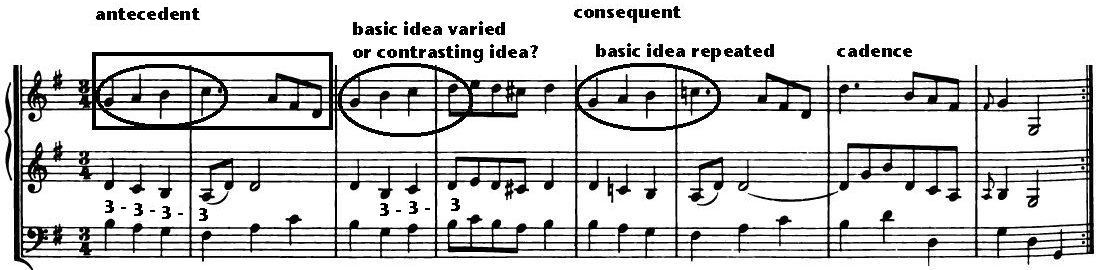
In K. 164, the trio to n6 is one of the periods that might have been read as a presentation-consequent theme:

Here the issue is clearly not bars 5-6, where bars 1-2 are literally repeated, in entirety. The issue is in bars 3-4, where the opening of the figure (bar 3) suggests "basic idea varied" and the end (bar 4) says "contrast." In general, I favor the effect of the opening, but in this case the strong contrast effected by a different direction for the parallel thirds in the accompaniment parts renders bar 5 a clear "return to the beginning" by contrast.

Here is a similar problem with a different result: K164n3, the trio:


Does bar 5 act like the opening of a consequent, rather than, as I have it, a continuation phrase? The "dogged adherence" to a figure would certainly suggest it, but what's lacking here is a sense of returning to the beginning, which a consequent must have. Here the sequence, going down by thirds (D-B-G in the melody), erases any sense of "starting over." If anything, this theme sounds like a six-measure phrase + a cadence.

Saturday, June 11, 2016

Mozart menuets and Caplin's theme types, part 2

This is a follow-up to yesterday's post that provided stats for theme types in the first strains of one early set of menuets (K. 164) and two late ones (K. 568 & 585).

Caplin's seven classes of eight-bar themes are as follows:

  • c1. period 

  • c2. sentence 
  • 
c3. period with modulating consequent 
  • 
c4. hybrid 1 (antecedent + continuation) 
  • 
c5. hybrid 2 (antecedent + cadence) 
  • 
c6. hybrid 3 (compound basic idea + continuation) 

  • c7. hybrid 4 (compound basic idea + consequent) 


These seven classes make up his list of all the eight-bar functional units commonly found in the music of the Vienna School (Haydn, Mozart, Beethoven; to which we could add Schubert). Only three from all possible combinations of the four-bar units are missing:

  • 1. presentation + consequent 
  • 2. presentation + cadential
  • 3. compound basic idea + cadential

I would designate presentation + consequent "hybrid 5" because examples do appear occasionally in dance music (as we saw in K. 164; a number of instances occur in Beethoven's dances, as well). I will add 2 & 3 to the list if I ever find any instances of them in music.

To be honest I think that for dance music those themes whose identity depends on particular harmonic shapes do not have anything like the importance that they can have for larger-scale instrumental concert music. For that reason, I would be content with just four classes:

  • c1. period
  • c2. sentence
  • c3. antecedent + continuation
  • c4. presentation + consequent

Within these, one may find variation in clarity of definition. Evaluating such differences can be useful as an interpretive tool. Here are examples from K. 164. In the trio of n2, we see the "classic" sentence design, where a basic idea is clearly repeated, though varied by transposition, and the continuation is built on fragmentation of the head-motive of the basic idea. A formula cadence then ends.


The menuet proper for n2 lies near the other extreme for the sentence: although the presentation phrase works just as it did in the trio above, the continuation introduces a new idea that holds nearly the same rhythm (without the grace note) but is otherwise strongly contrasting in character and presentation. Again a formula cadence follows.


The design of the menuet in n5 lies somewhere in between. The variation of the basic idea is more radical but is certainly still recognizable, but in the continuation we are offered something that sounds like a new idea -- observe the changed rhythm in bar 5, a small but telling moment in such confined quarters. Yet in retrospect we can recognize bars 5-6 as an informal mirror of bars 3-4. The question of such mirrors is a vexed one -- I am inclined toward viewing these as a separate class, which seems reasonable in that Caplin's theme types are grounded in melodic shapes (to which nuances of harmony are added).


Friday, June 10, 2016

Mozart, 6 Menuets, K. 164

The traditional narrative has the period theme dominating the Classical era (that is, European music roughly 1760-1820) but by the end of that time giving way to the sentence (Schoenberg's term): the preference for symmetry somehow turned to a preference for organic development. By now, we know well that this historical model misrepresents much of the music of this era. It certainly misrepresents music for dance.

My claim is that a variety of thematic types was typical of the 17th century and early 18th, as well, but gradually gave way to the symmetrical design of the period by the 1760s because of the popularity of the contredanse, which was based on music for the gavotte (duple time) and gigue (triple). Through most of the century, however, the menuet was prominent in maintaining one of the earlier theme types, the antecedent-continuation design (one of William Caplin's "hybrids"). The goal of my new research is to gain a better picture of just how thoroughly—and during which decades—this design was important.

Mozart provides a particularly good case study, as he was an avid dancer himself (and therefore knew intimately the requirements and changing fashions of dance), and he was also a prolific composer of music for dancing from an early age into the last year of his life, when he held a position as composer of dance music for the Imperial court.

The six orchestral menuets of K. 164 were composed in 1772. The scoring is for two violin parts and bass, augmented by trumpet and 2 oboes (or, sometimes, a solo flute). The designs for the first strain of each menuet and its trio are listed below.
  • n1: sentence
  • n1, trio: period 
  • n2: sentence 
  • n2, trio: sentence
  • n3: period
  • n3, trio: sentence
  • n4: antecedent-continuation
  • n4, trio: sentence
  • n5: presentation-consequent
  • n5, trio: sentence
  • n6: sentence
  • n6, trio: period
The two striking points are (1) the presence of a presentation-consequent hybrid, which Caplin regarded as too rare to even place among his set of hybrid themes; and (2) the prevalence of sentences: seven out of the twelve themes. So much for the narrative that says the sentence arises with Beethoven. In fact, it would seem to be just common sense that the sentence should be well suited to 18th century motive-driven Italianate models of composition and improvisation.

Here are the stats for K. 568, composed in 1788.
  • n1: sentence
  • n1, trio: period with transposed consequent
  • n2: period with transposed consequent
  • n2, trio: period
  • n3: antecedent-continuation
  • n3, trio: period
  • n4: antecedent-continuation
  • n4, trio: period
  • n5: period
  • n5, trio: period
  • n6: sentence
  • n6, trio: sentence* (with contrasting phrase)
  • n7: antecedent-continuation
  • n7, trio: period
  • n8: antecedent-continuation
  • n8, trio: period
  • n9: sentence
  • n9, trio: antecedent-continuation
  • n10: antecedent-continuation
  • n10, trio: period
  • n11: antecedent-continuation
  • n11, trio: sentence
  • n12: antecedent-continuation
  • n12, trio: period
Eleven of these themes are periods, only five are sentences, but eight are antecedent-continuation hybrids.

Here are the stats for K. 585, composed in 1789.
  • n1: sentence
  • n1, trio: period
  • n2: sentence
  • n2, trio: period
  • n3: antecedent-continuation
  • n3, trio: antecedent-continuation
  • n4: antecedent-continuation
  • n4, trio: antecedent-continuation or sentence with mirror variation of bi
  • n5: period
  • n5, trio: period
  • n6: period
  • n6, trio: period
  • n7: antecedent-continuation
  • n7, trio: sentence with continuous figure (motive)
  • n8: period
  • n8, trio: antecedent-continuation, but similar ci
  • n9: period
  • n9, trio: Period
  • n10: sentence
  • n10, trio: period
  • n11: antecedent-continuation
  • n11, trio: period
  • n12: period
  • n12, trio: period

For periods, n = 13; for sentences, n = 4; for antecedent-continuation hybrids, n = 7.

For the late menuets, then, periods do outnumber any other type, but constitute only about half of the total, with antecedent-continuation hybrids significantly represented and sentences by no means missing.

In the next post, I will discuss some examples of the antecedent-continuation hybrid from these three sets of menuets.

Tuesday, October 21, 2014

Additions to the literature on Caplin's form theory

This post expands on the previous one about William Caplin's form theory and the scholarly literature on it. 

For the present, this is simply a list of recently published articles. I hope to comment on individual items in future posts. I have not included work jointly published by or in response to Hepokoski and Darcy, Schmalfelt, and Caplin.

A special issue titled "Contemplating Caplin": Intersections: Canadian journal of music/Revue canadienne de musique XXXI/n1 (2010).

Peter Franck, "Canon and Its Effect on Tight-Knit Organization within Classical Themes." Intégral (Eastman School of Music) vol. 26 (2012).

Nathan Martin, "Formenlehre goes to the opera: Examples from Armida and elsewhere." Studia musicologica: An international journal of musicology of the Hungarian Academy of Sciences, 51/ns3-4 (2010): 387-404. 

Michael Oravitz, "The use of Caplin/Schoenberg thematic prototypes in melodic dictations." Journal of music theory pedagogy 26 (2012): 101-139.

Mark Richards, "Teaching sonata expositions through their order of cadences." Journal of music theory pedagogy 26 (2012): 215-252.

Mark Richards, "Viennese classicism and the sentential idea: Broadening the sentence paradigm." Theory and practice 36 (2011): 179-224.

Monday, October 20, 2014

William Caplin's form theory and 18th century dance

The scholarly literature making use of William Caplin's form theory is growing, if slowly. Some recent examples include Nathan Martin's "Schumann's Fragment," in Indiana Theory Review 28 (2010); Steven Vande Moortele's "Sentences, Sentence Chains, and Sentence Replication: Intra- and Interthematic Formal Functions in Liszt's Weimar Symphonic Poems," in Intégral 25 (2011); and Matthew Riley's "Haydn's Missing Middles," in Music Analysis 30 (2011).

Almost all of the work, so far as I can tell, has focused on extending the reach of the method deeper into the nineteenth century--even into the early twentieth. This tendency includes a rumored forthcoming book by Caplin himself. My interest, on the other hand, was originally in expanding the available style knowledge for the Vienna School composers by looking at their social dance repertoires. Obviously, their published work on its own is inadequate to describe the actual practice of music played for social dancing, but it is what we have. I worked out pages with analyses of menuets, German dances, and Laendler by Beethoven: WoO7, WoO8, WoO11, WoO14, and WoO15; and contredanses by Mozart and Beethoven (all of these were accessible from a website, but the server has been decommissioned). This work was extended to a few contemporaries, notably Czerny, Hummel, Marschner, and Weber.

The principal results to date are that the historical narrative charting a turn from the period theme to the sentence over the course of the Vienna School heyday, or roughly 1770-1830, is incorrect. The period does become much more prevalent at one historical moment -- about 1770, when the French style of contredanse became popular in Vienna. (This was due to the fact that French contredanse music was heavily oriented to the gavotte, whose dance figures effectively required an antecedent-consequent design in the music.) But even after 1770, the period co-existed with other theme types, including the sentence and the hybrid antecedent-continuation. The latter, in fact, was far more congenial to the menuet than was the period, for the reason that the dance emphasized variety of detail, and a theme with antecedent-continuation offers more variety than any other theme type. Indeed, if the composer chooses, every 2-bar unit of this theme can be different: basic idea followed by a contrasting idea, followed by another idea (or fragmentation of a new model), followed by the generic cadence. (Its antipode is the hybrid presentation-consequent, a type so rare in the Vienna School repertoire that Caplin deletes it. It does, however, have a role to play in the Laendler repertoire, which tends to emphasize sameness within strains but contrast between strains.)

As the preceding suggests, once the influence of the French contredanse was established, I wanted to look into earlier dance repertoires. To date, this work has extended as far back as the English country dances in the Playford collections, which confirm the variety of theme types (sentences are surprisingly common, for example) but also highlight the extent to which French court dance practices tended to reduce the number of available theme types.

In the course of all this work, I have also realized that Caplin's catalogue of theme types does not work as well as one would like for some of the subtler idea and phrase length figures common in the social dance repertoire, and my goal over the next few months is to revise (or expand) his taxonomy to account for these, the goal continuing to be to acquire useful style information.

Sunday, October 19, 2014

Peter Franck on Canon (Imitation)

Peter Franck, "Canon and Its Effect on Tight-Knit Organization within Classical Themes." Intégral (Eastman School of Music) vol. 26 (2012), 1-45.

A well-written, clearly organized presentation on how canonic passages can be interpreted within theme-sized units. Beethoven and Haydn do figure, but the great majority of the repertoire discussed is by Mozart. Although "canon" is in the title, the author is actually talking about "canon and imitation," as he acknowledges almost immediately (2).

The distinction between tight-knit and loose organization that is central to William Caplin's form theory is in the foreground of the argument, but as canonic passages seem to find a place in all segments of different types of themes (occasionally including entire themes), the article's strength lies not in revealing some particular "effect" of canon but rather in offering a useful style survey.