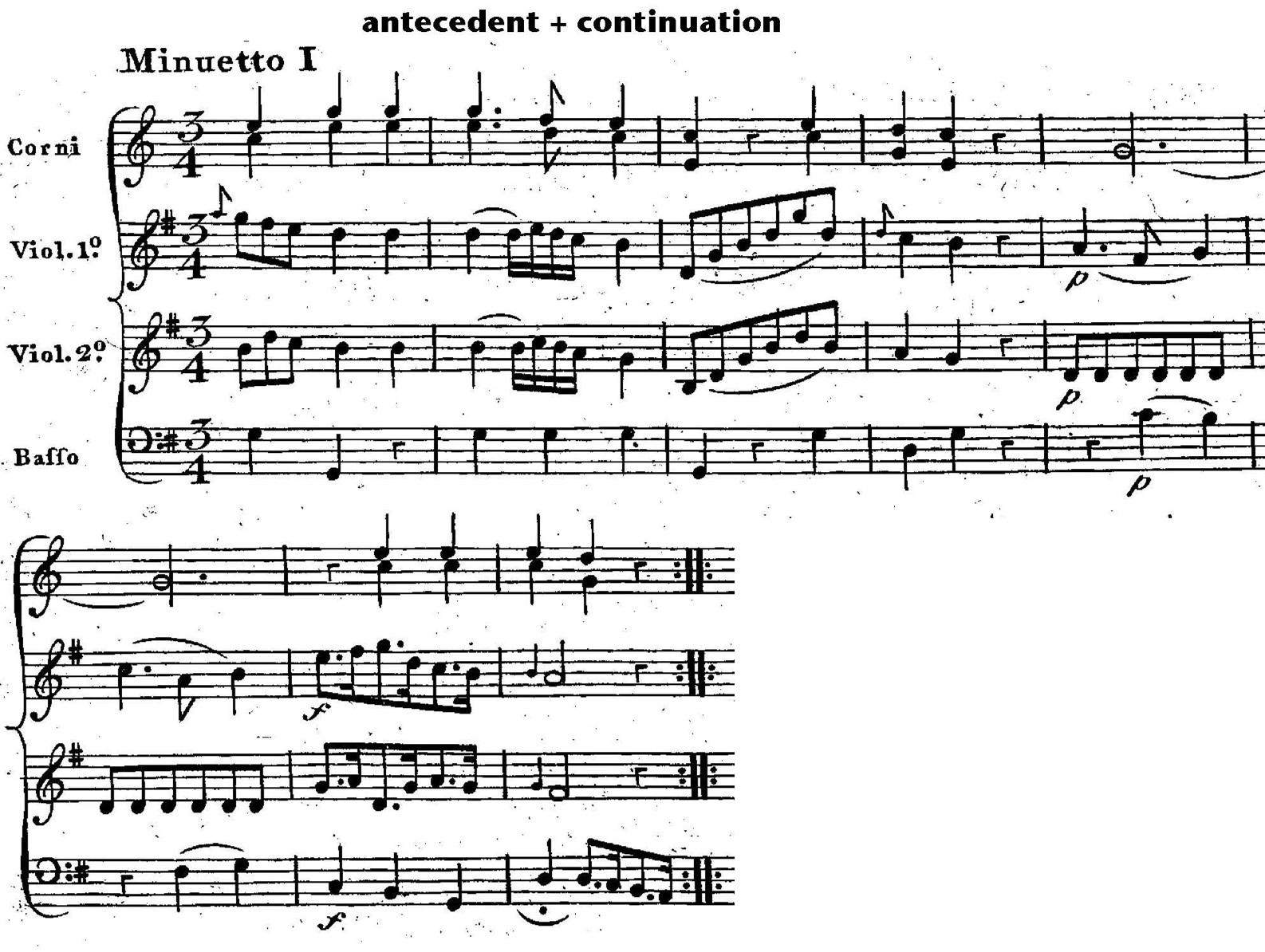
Antonio Sacchini was a student of Francesco Durante and thus thoroughly trained in the Neapolitan manner we associate now with partimento improvisation, accompaniment, and composition. Sacchini became one of the foremost exponents of the prevailing Italian style across Europe, beginning in Rome, Florence, and Venice (from which he also traveled to Germany), but moving on to London, where he stayed for a decade, and finally to Paris, where Marie Antoinette was his patron. He died in 1786.
A set of six menuets for string trio and two horns was published in London, presumably during his residence there (between 1772 and 1781).
No. 5. The simplest of periods, where the only change is in the phrase-ending bars (boxed).
No. 4. A classic sentence with an answering transposition in bars 3-4 and fragmentation to start the continuation phrase.
No. 3. Here Sacchini maintains the basic sentence structure but emphasizes contrast rather than developmental continuity. Note the change of dynamic in bar 3 and again in bar 5, as well as the strong contrast in the two ideas of the continuation phrase.
No. 1. Here every idea is different -- what I call a galant theme, with contrast as the expressive goal.
No. 2. Very similar to the preceding.
No. 6
Showing posts with label 16mm theme. Show all posts
Wednesday, July 5, 2017
Monday, June 26, 2017
Bach menuet themes 4, compound themes
16-bar period
French Suite No. 1 in D minor, II
French Suite No. 3 in B minor, I
Partita No. 1 in Bb major, I
Suite in E major for Lute, BWV 1006a, II
16-bar sentence
English Suite No. 4 in F major, I
14-bar antecedent + continuation (but A = 36 bars!)
Suite in A major for Violin, BWV 1025
Of the five 16-bar themes, three have sentences in their first 8-bar units, two have periods.
16-bar period
French Suite No. 1 in D minor, II. The 8-bar consequent is close to the antecedent in its basic progression and figures, but Bach does work in a number of embellishing variants (and a bit of invertible counterpoint: compare bars 5 and 12).
French Suite No. 3 in B minor, I. Here the 8-bar consequent is a literal repetition of the antecedent except in the cadence.
Partita No. 1 in Bb major, I. This sort of dense motivic play within the sentence design undoubtedly fascinated the early Romantics.
Suite in E major for Lute, BWV 1006a, II. Alterations in the 8-bar consequent begin immediately after the repetition of the basic idea (earlier than in the preceding Partita menuet) in service of the modulation.
16-bar sentence
English Suite No. 4 in F major, I. Compound sentences are not common in any era, compared to the 16-bar and even 32-bar period. This example is even more remarkable in that the 8-bar presentation is a period. (Yes, I have on several occasions objected to Caplin's confusing repurposing of the terms for 8-bar themes to map onto 16-bar themes. I have yet to come up with anything better, however.)
14-bar antecedent + continuation (but A = 36 bars!)
Suite in A major for Violin, BWV 1025. This is of an entirely different order from the other 27 pieces Bach named "menuet." Obviously an expanded instrumental concert piece in the Italian manner, it offers us only one point for comparison -- its opening, which I have read as a 14-bar antecedent + continuation theme. The intertwining of the treble parts makes the articulations hard to find, and I have relied substantially on the bass, whose figures--boxed--are quite clear as 8 + 6 bars. In the first half of the antecedent (bars 1-4) the two treble voices are almost in unison, as one might expect in the tutti sections of an Italian concerto. At bar 5 they break apart in the manner of the concertino, with the principal melody in the keyboard (see the arrow). The cadence articulation is largely concealed by the overlapping figures: the violin's long note in bar 7 suggests an ending there, but it is contradicted by the seventh (D5) in the other treble part; in bar 8, the keyboard line finishes (D5 resolving to C#5, B5 to A5), while the violin simultaneously leads into the next bar as a pickup.
French Suite No. 1 in D minor, II
French Suite No. 3 in B minor, I
Partita No. 1 in Bb major, I
Suite in E major for Lute, BWV 1006a, II
16-bar sentence
English Suite No. 4 in F major, I
14-bar antecedent + continuation (but A = 36 bars!)
Suite in A major for Violin, BWV 1025
Of the five 16-bar themes, three have sentences in their first 8-bar units, two have periods.
16-bar period
French Suite No. 1 in D minor, II. The 8-bar consequent is close to the antecedent in its basic progression and figures, but Bach does work in a number of embellishing variants (and a bit of invertible counterpoint: compare bars 5 and 12).
French Suite No. 3 in B minor, I. Here the 8-bar consequent is a literal repetition of the antecedent except in the cadence.
Partita No. 1 in Bb major, I. This sort of dense motivic play within the sentence design undoubtedly fascinated the early Romantics.
Suite in E major for Lute, BWV 1006a, II. Alterations in the 8-bar consequent begin immediately after the repetition of the basic idea (earlier than in the preceding Partita menuet) in service of the modulation.
16-bar sentence
English Suite No. 4 in F major, I. Compound sentences are not common in any era, compared to the 16-bar and even 32-bar period. This example is even more remarkable in that the 8-bar presentation is a period. (Yes, I have on several occasions objected to Caplin's confusing repurposing of the terms for 8-bar themes to map onto 16-bar themes. I have yet to come up with anything better, however.)
14-bar antecedent + continuation (but A = 36 bars!)
Suite in A major for Violin, BWV 1025. This is of an entirely different order from the other 27 pieces Bach named "menuet." Obviously an expanded instrumental concert piece in the Italian manner, it offers us only one point for comparison -- its opening, which I have read as a 14-bar antecedent + continuation theme. The intertwining of the treble parts makes the articulations hard to find, and I have relied substantially on the bass, whose figures--boxed--are quite clear as 8 + 6 bars. In the first half of the antecedent (bars 1-4) the two treble voices are almost in unison, as one might expect in the tutti sections of an Italian concerto. At bar 5 they break apart in the manner of the concertino, with the principal melody in the keyboard (see the arrow). The cadence articulation is largely concealed by the overlapping figures: the violin's long note in bar 7 suggests an ending there, but it is contradicted by the seventh (D5) in the other treble part; in bar 8, the keyboard line finishes (D5 resolving to C#5, B5 to A5), while the violin simultaneously leads into the next bar as a pickup.
Monday, June 19, 2017
Menuet series 2-8: Johann Sebastian Bach
"J.S. Bach’s 28 titled minuets occur in his keyboard partitas and suites, in chamber music for solo and accompanied violin, cello or flute, in three of the four orchestral suites, and in the Brandenburg Concerto no.1" (Little and Jenne, 1991; cited in Meredith Ellis Little, "Minuet," Oxford Music Online).
Here is my version of the list of 28:
1.-2. English Suite No. 4 in F majorHere are the formal functions in the first strains:
3.-4. French Suite No. 1 in D minor
5. French Suite No. 2 in C minor
6.-7. French Suite No. 3 in B minor
8. French Suite No. 6 in E major
9.-10. Partita No. 1 in Bb major
11. Partita No. 4 in D major
12. Partita No. 5 in G major
13.-14. Brandenburg Concerto No. 1
15. Suite in A major for Violin, BWV 1025
16.-17. Suite in Eb major for keyboard, BWV 819
18.-19. Suite in E major for Lute, BWV 1006a
20.-21. Orchestral Suite No. 1 in C major
22.-23. Orchestral Suite No. 4 in D major
24. Orchestral Suite No. 2 in B minor
25.-26. Cello Suite No. 1 in G major
27.-28. Cello Suite No. 2 in D minor
Antecedent + continuation: 7 + 1*And here is the list again by form function category:
Period: 10
Sentence: 2
Presentation + consequent: 1
12-bar sentence: 2
16-bar period: 4
16-bar sentence: 1
Antecedent + continuation; n = 7To establish some context for Bach's menuets, here is a table with data on music discussed in this series so far:
French Suite No. 1 in D minor, I
French Suite No. 2 in C minor
French Suite No. 3 in B minor, II
Suite in E major for Lute, BWV 1006a, I
Orchestral Suite No. 4 in D major, II
Orchestral Suite No. 2 in B minor
Cello Suite No. 2 in D minor, II
Antecedent + continuation (but A = 36 bars!); n = 1
Suite in A major for Violin, BWV 1025
Period; n = 10
English Suite No. 4 in F major, II
Partita No. 1 in Bb major, II
Partita No. 4 in D major
Brandenburg Concerto No. 1, II
Suite in Eb major for keyboard, BWV 819, I
Orchestral Suite No. 1 in C major, I
Orchestral Suite No. 1 in C major, II
Orchestral Suite No. 4 in D major, I
Cello Suite No. 1 in G major, I
Cello Suite No. 2 in D minor, I
Sentence; n = 2
French Suite No. 6 in E major
Suite in Eb major for keyboard, BWV 819, II
Presentation + consequent; n = 1
Cello Suite No. 1 in G major, II
12-bar sentence; n = 2
Partita No. 5 in G major
Brandenburg Concerto No. 1, I
16-bar period; n = 4
French Suite No. 1 in D minor, II
French Suite No. 3 in B minor, I
Partita No. 1 in Bb major, I
Suite in E major for Lute, BWV 1006a, II
16-bar sentence; n = 1
English Suite No. 4 in F major, I
I cannot emphasize too strongly that this is not a comprehensive picture of menuet history from 1660 to 1730. It is more of a snapshot, but in it we can nevertheless see some things of interest. (1) The antecedent + continuation theme is the only type other than the period to be found in every sample set, from Lully to Bach. (2) Conversely, the sentence is entirely missing from the early sample sets and is weakly represented still in the later ones (with the exception of Fux). (3) Similarly, what Caplin calls "compound themes" are missing in the earlier sample sets but show up clearly in later ones (note 16-bar periods in Rameau, Chédeville, and Bach).
In subsequent posts, I will discuss individual menuets by Bach, organizing the posts in terms of formal functions, as above, rather than by source.
Labels:
16mm theme,
antecedent-continuation,
Bach,
menuet,
sentence,
theme types
Wednesday, June 14, 2017
Menuet series 2-5 (Menuets by Rameau)
This sampling of named menuets by Jean Philippe Rameau includes two menuet-trio pairs each from the operas Hippolyte (1733) and Les Indes Galantes (1735), plus one menuet-trio from the keyboard works, for a total of ten pieces. As with Couperin, a substantial number of other pieces in the keyboard works are undoubtedly menuets but are given other, non-dance titles.
For the first strains of each of the ten items:
Period:
Les_Indes_Galantes-menuet 1. A textbook period, except for the ending on V.
Hippolyte_menuet 2. One might be tempted to call this a sentence if one followed the up-and-down meandering of the opening rhythmic figure, but it seems clear that contrast is the goal in the first phrase (note the orchestration) and in any case the upper voice in bars 3-4 is a common melodic cliché of the menuet. Equally, bars 5-6 are meant to recall the beginning, even if the pitches are flipped.
Sentence:
Hippolyte_menuet 1. The continuation is more contrast than development, though one could, I suppose, point to the flipped rhythms (bar 5 = bar 2; bar 6 = bar 1).
Les_Indes_Galantes-menuet 2. The first phrase is very close in design to the first phrase of the preceding example. The second phrase is contrasting, though it does use fragmentation (that is, one-bar elements).
Antecedent + continuation:
Hippolyte_menuet 1 trio. Here again, the continuation is really a contrasting phrase with fragmentation.
Les_Indes_Galantes-menuet 1 trio. The antecedent+continuation theme can achieve maximum contrast, as it does here, in aid of instrumentation and dynamic contrasts.
Les_Indes_Galantes-menuet 2 trio. Every two-bar idea is different.
16-bar period, where 8-bar antecedent = antecedent + continuation:
In all three examples below, the overall period design is very clear. In the eight-bar antecedent, its own antecedent phrase (bars 1-4) is what I call a "weak antecedent" (contrasting ideas but no cadence), or what Caplin calls a "compound basic idea."
Hippolyte_menuet 2 trio.
Pieces_troisieme_recueil_menuet
Pieces_troisieme_recueil_menuet trio
For the first strains of each of the ten items:
Hippolyte_menuet 1: sentenceThe same information by theme type:
Hippolyte_menuet 1 trio: antecedent + continuation
Hippolyte_menuet 2: period?
Hippolyte_menuet 2 trio: 16 bar period (8-bar antecedent = antecedent + continuation)
Les_Indes_Galantes-menuet 1: period
Les_Indes_Galantes-menuet 1 trio: antecedent + continuation
Les_Indes_Galantes-menuet 2: sentence with contrasting phrase
Les_Indes_Galantes-menuet 2 trio: antecedent + continuation with HC
Pieces_troisieme_recueil_menuet: 16 bar period (antecedent is antecedent + continuation)
Pieces_troisieme_recueil_menuet trio: 16 bar period (antecedent is antecedent + continuation)
Period: Les_Indes_Galantes-menuet 1Here are examples, first strains only, in the order of the list by theme type above. In some of the examples, note the use of the French violin clef.
Hippolyte_menuet 2
Sentence: Hippolyte_menuet 1
Les_Indes_Galantes-menuet 2
Antecedent + continuation: Hippolyte_menuet 1 trio
Les_Indes_Galantes-menuet 1 trio
Les_Indes_Galantes-menuet 2 trio
16-bar period, where 8-bar antecedent = antecedent + continuation:
Hippolyte_menuet 2 trio
Pieces_troisieme_recueil_menuet
Pieces_troisieme_recueil_menuet trio
Period:
Les_Indes_Galantes-menuet 1. A textbook period, except for the ending on V.
Hippolyte_menuet 2. One might be tempted to call this a sentence if one followed the up-and-down meandering of the opening rhythmic figure, but it seems clear that contrast is the goal in the first phrase (note the orchestration) and in any case the upper voice in bars 3-4 is a common melodic cliché of the menuet. Equally, bars 5-6 are meant to recall the beginning, even if the pitches are flipped.
Sentence:
Hippolyte_menuet 1. The continuation is more contrast than development, though one could, I suppose, point to the flipped rhythms (bar 5 = bar 2; bar 6 = bar 1).
Les_Indes_Galantes-menuet 2. The first phrase is very close in design to the first phrase of the preceding example. The second phrase is contrasting, though it does use fragmentation (that is, one-bar elements).
Antecedent + continuation:
Hippolyte_menuet 1 trio. Here again, the continuation is really a contrasting phrase with fragmentation.
Les_Indes_Galantes-menuet 1 trio. The antecedent+continuation theme can achieve maximum contrast, as it does here, in aid of instrumentation and dynamic contrasts.
Les_Indes_Galantes-menuet 2 trio. Every two-bar idea is different.
16-bar period, where 8-bar antecedent = antecedent + continuation:
In all three examples below, the overall period design is very clear. In the eight-bar antecedent, its own antecedent phrase (bars 1-4) is what I call a "weak antecedent" (contrasting ideas but no cadence), or what Caplin calls a "compound basic idea."
Hippolyte_menuet 2 trio.
Pieces_troisieme_recueil_menuet
Pieces_troisieme_recueil_menuet trio
Labels:
16mm theme,
antecedent-continuation,
menuet,
Rameau,
sentence
Thursday, June 16, 2016
Lully and Playford
To provide some context for the two previous posts, in which I described the design of menuets from three Lully operas, here is a figure from my PDF essay on dance design (link). This is also Table 1 in my 2006 article on the contredanse and the finales of Haydn and Mozart sonatas and symphonies (link).
A tabulation of design for first strains of music in various editions of Playford's English Dancing Master (all editions after the first: Dancing Master). The first edition was published in 1651, the seventeenth (and last) in 1728.
What I call "4-bar themes" are similar to Lully's first strains that are really phrases, not themes in Caplin's sense. In Playford's first edition, these 4-bar themes predominate (see the second column in the table). Next in line are the sentence and the antecedent-continuation model, confirmation of the importance of both in 17th century music. In the later editions (see the third column), the obvious change is what we might call the rise of the period and a drop in the number of sentences.
Here is one example of a dance whose music starts with a "4-bar theme": Lady Cullen. "Theme" and "section" are the same, if one takes the repeat sign as a section demarcator, in the same way as in almost all later dances. If we include the repeat, then the resulting eight bars (that is, mm. 1-4 twice) are a period (though an awkward one in which the antecedent closes on the tonic). If we regard the entire piece (mm. 1 to 4 + 5 to 8) as a single theme, then it is antecedent-continuation. If we include all repeats (1 to 4 + 1 to 4 + 5 to 8 + 5 to 8), the result is a compound (16-measure) sentence.
"4-bar theme"; antecedent of an antecedent-continuation; (with repeat) period; presentation unit of a 16-measure sentence. Of course, the actual design of Lady Cullen when used for dancing will be this: if L stands for the music, then LLLLLLLL. . . as many times as needed for all to complete the figures (this is a long dance, where the length of the dance depends on the number of people dancing).
All this reminds us (1) that the formal function depends on the level one is considering; (2) that Caplin's model does have an unfortunate repetition of labels at 8-bar and 16-bar levels; (3) that in 17th century music there is a fluid relationship between phrase, section, and theme.
A tabulation of design for first strains of music in various editions of Playford's English Dancing Master (all editions after the first: Dancing Master). The first edition was published in 1651, the seventeenth (and last) in 1728.
What I call "4-bar themes" are similar to Lully's first strains that are really phrases, not themes in Caplin's sense. In Playford's first edition, these 4-bar themes predominate (see the second column in the table). Next in line are the sentence and the antecedent-continuation model, confirmation of the importance of both in 17th century music. In the later editions (see the third column), the obvious change is what we might call the rise of the period and a drop in the number of sentences.
Here is one example of a dance whose music starts with a "4-bar theme": Lady Cullen. "Theme" and "section" are the same, if one takes the repeat sign as a section demarcator, in the same way as in almost all later dances. If we include the repeat, then the resulting eight bars (that is, mm. 1-4 twice) are a period (though an awkward one in which the antecedent closes on the tonic). If we regard the entire piece (mm. 1 to 4 + 5 to 8) as a single theme, then it is antecedent-continuation. If we include all repeats (1 to 4 + 1 to 4 + 5 to 8 + 5 to 8), the result is a compound (16-measure) sentence.
"4-bar theme"; antecedent of an antecedent-continuation; (with repeat) period; presentation unit of a 16-measure sentence. Of course, the actual design of Lady Cullen when used for dancing will be this: if L stands for the music, then LLLLLLLL. . . as many times as needed for all to complete the figures (this is a long dance, where the length of the dance depends on the number of people dancing).
All this reminds us (1) that the formal function depends on the level one is considering; (2) that Caplin's model does have an unfortunate repetition of labels at 8-bar and 16-bar levels; (3) that in 17th century music there is a fluid relationship between phrase, section, and theme.
Labels:
16mm theme,
Caplin,
country dance,
Lully,
Playford,
theme types
Thursday, January 3, 2013
Air no. 3 in rondeau
To demonstrate how easily designs for social dance music can be (and almost certainly were) manipulated to create different sequences, here is Bacquoy-Guedon's Air no. 3 [see previous post] reconstructed: (1) to expand the opening section to a 16mm theme, a period whose antecedent is the original 8-bar period and whose consequent alters the ending to form a perfect authentic cadence (PAC); (2) to create the five-part rondeau design, ABACA, that is frequently found in French contredanse publications, especially later in the 18th century. My version differs from those of Clarchies in that section C is in the original key, where a trio-like minor-key strain would be more likely. It does, however, introduce some chromaticism (in F-nat5) and is an unusual length (12 bars rather than 8). With all the repeats included, and assuming one second per bar, this rondeau design yields over two minutes of music.
Other examples of this kind of formal manipulation may be found in chapter 2 of my PDF essay Dance Designs in 18th and Early 19th Century Music: link. [NOTE: link updated 6-09-16]
Subscribe to:
Posts (Atom)