Showing posts with label antecedent-continuation. Show all posts

Thursday, March 1, 2018

Krähmer, 12 Ländler

Ernest Krähmer was born near Dresden, educated and began his career in that city, then moved to Vienna, where he was an oboist in the Kärthnertor-Theater and subsequently in the court orchestra. He was also very successful as the primary Csakan virtuoso, an instrument keyed in Ab that became known as the "Romantic recorder" and was very popular during Krähmer's lifetime (he died in 1841) but quickly fell out of favor thereafter. (Information here is translated from the German Wikipedia articles on Krähmer and the Stockflöte. For images of modern reproductions of the instrument, go here: link.)

In my previous post on the Ländler of František Pecháček, I wrote in connection with his 12 Ländler (1801) that they represent the "violinistic Ländler in its traditional form—as distinct from the later keyboard Ländler of Schubert and many other composers in the 1820s, who strive to make the Ländler congenial and specific to the piano, holding to the form and characteristic figures but using less common keys often with chromatic twists and exaggerated registral play, the result being to blur the distinction between music for dance and music for recital."  The Csakan, keyed in Ab, obviously made its own contribution to this shift—indeed, Krähmer and his wife Caroline Schleicher "performed regularly together in Vienna, he on the oboe and the csakan, she on the violin and the clarinet" (translation from the German Wikipedia article on Krähmer).

In the spirit of clarification, however, I remind the reader that the confusion of menuet, Ländler, and Deutscher Tanz [German dance] was at its highest in the first quarter of the 19th century. The dances were still easily distinguishable but the musics for them were not. The music of menuet and German dance had begun to intersect substantively in the 1780s at the latest, as we know from the symphonies and chamber music of Haydn, Mozart, and their contemporaries. In the trios of their menuet movements—especially with Mozart—the distinctive figures of the violinistic Ländler were also sometimes heard, though these can be hard to distinguish from a general pastoral affect. After 1800, things became much worse, a key figure demonstrating that change being Schubert, who is known to have used the label Ländler, Deutscher Tanz, or Walzer in different copies of the same piece. (Publishers were no help in this regard, either.) Walzer was the generic later 18th century term for "turning dances," which included both Ländler and Deutscher Tanz even though their steps, figures, and tempi were quite different. As things stood around 1815, the music of the Ländler was usually quieter and slower than the Deutscher Tanz and preserved more of the traditional figures, where the Deutscher Tanz usually still sounded like the hybrid type of the 1780s. Only in the 1830s, when the tempo of dances generally sped up did the distinction largely disappear and pieces were almost always called Walzer.

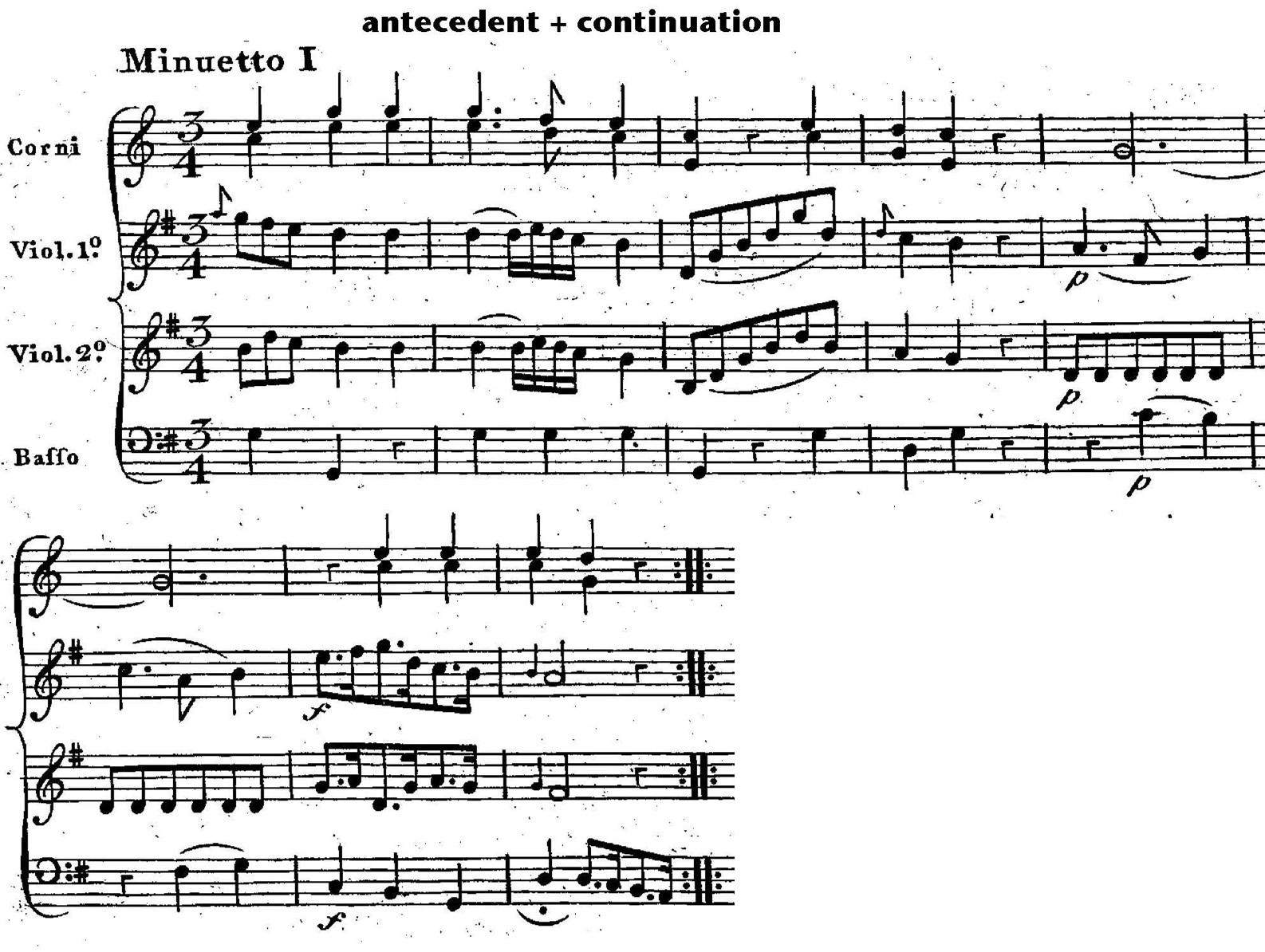
All this being said, the first piece in Krähmer's 12 Ländler (published in 1827) is quite obviously a Deutscher Tanz:


(The modern notation is by Hans-Thomas Müller-Schmidt; downloaded from IMSLP.) Note that the first strain is an antecedent + continuation theme, or what I call the "galant" theme because of its overwhelming importance in the second half of the 18th century: every one of the 2-bar ideas is different. The explanation, perhaps, is that this was intended as a promenade, a regular feature of any extended dance set (Beethoven included one to begin the 12 German Dances, WoO8 (1795), for instance).

The second piece in the set is much more like a Ländler, with soft dynamic, predominantly eighth-note rhythms, and characteristic phrase-ending figures. The chromaticism, however, is distinctive (Schubertian?). The theme is a period.


The third number shows a different side of the Ländler: soft dynamic and phrase-ending clichés but consistent quarter-note rhythms. The B-section would also be familiar to Krähmer's listeners as belonging to rural Ländler practices: the Schnadahüpfel (where the often delicate turning figures of the Ländler are briefly interrupted by loud stomping).


On the Schnadahüpfel, see this post on my Schubert blog: link.
Information on the confusion of waltz-family types draws especially on work by Walburga Litschauer. See these posts on my Schubert blog: link; link; link; link.

Friday, January 19, 2018

New publication: Part 5 of the Mozart Form Functions Series

I have published a new essay on Texas Scholar Works. The title is Formal Functions in Menuets by Mozart, Part 5: More to Theoretical Issues: link. Here is the abstract.
This essay considers some theoretical questions raised at the end of Part 4 in this series. William Caplin’s theory of formal functions in Haydn, Mozart, and Beethoven stipulates that themes are of two primary types (period, sentence) and several secondary types (“hybrids”). These need to be resorted in order to account for eighteenth-century practice more broadly, following from the results of the work in this series, Parts 1-4.

Sunday, August 20, 2017

Menuet survey summary

A longer-term goal of the menuet survey—which still needs entries on J. C. Bach and Mozart—has been a large documentation essay to be published eventually, like others, on the Texas Scholar Works platform. At this mid-point in the series of posts (I plan to examine a large number of menuets by Mozart), a summary of the argument might be useful:
This essay historicizes hybrid themes (after Caplin) in terms of first strains in named menuets and (secondarily) first sections in instrumental movements clearly based on the menuet. The antecedent-continuation theme is renamed "galant theme," and—for the purpose of the dance—the list of eight-bar themes is reduced to four: period, sentence, galant theme, and presentation-consequent. This last I sometimes refer to as the "6+2 theme."

Wednesday, July 5, 2017

Menuet series 3-1 (Sacchini)

Antonio Sacchini was a student of Francesco Durante and thus thoroughly trained in the Neapolitan manner we associate now with partimento improvisation, accompaniment, and composition. Sacchini became one of the foremost exponents of the prevailing Italian style across Europe, beginning in Rome, Florence, and Venice (from which he also traveled to Germany), but moving on to London, where he stayed for a decade, and finally to Paris, where Marie Antoinette was his patron. He died in 1786.

 A set of six menuets for string trio and two horns was published in London, presumably during his residence there (between 1772 and 1781).

No. 5. The simplest of periods, where the only change is in the phrase-ending bars (boxed).


No. 4. A classic sentence with an answering transposition in bars 3-4 and fragmentation to start the continuation phrase.


No. 3. Here Sacchini maintains the basic sentence structure but emphasizes contrast rather than developmental continuity. Note the change of dynamic in bar 3 and again in bar 5, as well as the strong contrast in the two ideas of the continuation phrase.


No. 1. Here every idea is different -- what I call a galant theme, with contrast as the expressive goal.


No. 2. Very similar to the preceding.


No. 6


Sunday, July 2, 2017

Menuet series 2-13 (Telemann)

Telemann cultivated the galant style in a serious way. His keyboard music and sonatas and fantasies for violin, however, are poor sources for menuets -- many are written in the three-movement design Allegro-Andante-Allegro -- and I turned to the orchestral works for examples. Because that repertoire is very large, I arbitrarily worked with overtures (suites) whose home keys are G or A.

This sentence fits the model quite well. The modern notation, btw, is by Michel Rondeau. I have included only the two clarino parts (identical to violin 1 & 2) and the bass.


This is quite similar to the first example above.


Here is a good example of the galant theme: antecedent + a continuation phrase that contrasts rather than develops.


Here there is less contrast because of the repetition of the basic idea's rhythms.


And here is a case that radicalizes the above. The same rhythms in every bar but the last bring much closer attention to shapes. In such a constrained context, bars 3-4 do sound like a contrasting idea and bars 5-6 like a second contrasting idea. Note that there are some broader connections: the arches showing the same overall direction in each phrase and the motivic ground in the basic idea and in bars 5-6.

Saturday, July 1, 2017

Menuet series 2-12 (Gottlieb Muffat)

Another close contemporary of J. S. Bach, Gottlieb Muffat—who was Georg's son—worked throughout the first half of the 18th century in the Viennese court (among his students was the future Empress Maria Theresa). The six suites in the Componimenti musicali (~1739) contain 13 menuets. Here are comments on several of them.

Suite no. 5, the trio to the second menuet, offers a simple presentation phrase, but the continuation emphasizes contrast, not development. So although I have called it a sentence, this first strain really belongs to a separate category, presentation + contrast, a design that is not only common in the menuet, along with the allied antecedent + contrast, but becomes more and more so in the second half of the 18th century, to the point that it is the preferred form for menuets by J. C. Bach and Mozart.


Suite no. 1, trio to the menuet. Similar to the preceding.


Suite no. 5, second menuet. A "classic" antecedent + continuation theme, with considerable fragmentation in bars 5-7.

Suite no. 6, trio to the menuet. The distinctiveness of the chromatic figure, the placement of the mirror at bar 5, and the extent of the mirroring all favor hearing this theme as a period.


Suite no. 2, menuet. A reasonably straightforward period; the transposition of the basic idea in the consequent is substantial but the arpeggio figure with the rhythms maintained makes the relationship clear.


Suite no. 6, menuet. The formal functions as a "galant theme" make sense. This one is interesting because of the mirroring of rhythms -- see the two (a)s and the two (b)s -- and shapes -- the two (a)s. Despite the mirroring, the continuation phrase is contrasting rather than developmental.

Suite no. 2, trio. Once again the continuation is a contrasting phrase. The presentation is extended by simply adding two bars that transpose bars 3-4 down a third.


Suite no. 6, "menuet III." The previous example hints at a figure realized in this one. I have labeled the formal functions as a sentence, but the effect overall is not 4 + 4 but rather 6 + 2: three statements of an idea followed by a formula cadence with a different melodic figure.


Much the same effect occurs in the 8-bar antecedent of the 16-bar period in J. S. Bach's French Suite in D minor, menuet II. Look especially at the alto voice (arrow).


We will see this 6 + 2 arrangement—and even its reverse, 2 + 6!—in menuets by later composers.

Friday, June 30, 2017

Menuet series 2-11 (Graupner)

Christoph Graupner, like J. S. Bach and Telemann, was a professional musician in north Germany—he spent most of his career in Darmstadt, whose Universitäts- und Landesbibliothek holds a manuscript collection of 20 dances (IMSLP link).

No. 7: A "textbook" period to begin. Note that the upper staff is written with the French violin clef.


No. 10: A fairly simple "galant theme" though the repetition of the bass figure through the first four bars undercuts contrast in bars 3-4.


No. 11: The opposite case: the bass changes direction after the scalar descent in bars 1-2, but the melody in bar 3 repeats the rhythm of bar 1. This first strain is on the fence, so to speak, between galant theme and sentence.


Thursday, June 29, 2017

Menuet series 2-10 (Georg Muffat)

The goal in this section of the menuet series is to make comparisons between J. S. Bach and his German contemporaries (in the earlier series it was French predecessors and contemporaries). To begin, here is a table with data:


The numbers for Bach are the 28 named menuets, that number identified by Jenne and Little (link to earlier post). For the others also, I used only movements named menuet in solo and chamber music. Sources will be identified in posts on the individual composers.

One obvious point to be made is the large number of periods in Georg Muffat's music (he was an older contemporary, born in 1653), but the significant drop relative to antecedent + continuation and sentence themes in Bach's close contemporaries (Gottlieb Muffat, Graupner, and Telemann).

As with all the work in this series of posts, the "data" were gathered opportunistically and I do not pretend that they are complete, especially as I firmly restricted myself to named menuets. Many other pieces, especially rondeau themes, are obviously also menuets. And of course my restriction meant that the entire eighteenth-century song repertoire was excluded.

I found four collections by Georg Muffat on IMSLP (link): orchestral—Armonico tributo, published in Salzburg in 1682; Florilegium Primum, published in Augsburg in 1695; Florilegium Secundum, published in Passau in 1698—and six keyboard partitas in an undated manuscript, for which I am using modern notation by John Phelan.

From these last, as clean an 8-bar period as one could want. Note that the antecedent is set with the familiar chaconne bass figure, but that rhythm and direction clearly separate the contrasting idea from the basic idea. (Partita no. 5, menuet II)


Here is another example. This is from the first suite in the Armonico tributo, first violin part only. Note the "Allegro è forte." Throughout its history, the menuet took on both ceremonial-processional and pastoral characters with equal ease.


From Partita No. 2, the second menuet. The addition of ornamentation in the consequent does not in any way disturb the senses of symmetry and return. It is highly likely that this little piece reflects common performance practice, especially by keyboard players but almost certainly by others, as well.


From Florilegium Primum, suite no. 6. Ornamentation can also cause problems for analysis, as here. I first identified this as a sentence, assuming that the noodling in bars 5-6 were the functional equivalent of fragmentation. The lower parts, however, clearly mark bars 5-6 as a repetition of bars 1-2, and thus I conclude that the design is presentation + consequent—reluctantly, to be sure, because, as Caplin notes, this is a rare form (so much so that he doesn't even include it in his list of hybrid themes). The presentation + consequent theme is indeed rare throughout the entire history of the menuet. (The modern notation, btw, was made originally for the Werner Icking Music Collection by an editor identified only as "kompy.")


The final example from Muffat is from Florilegium Secundum, suite no. 4. I will continue to emphasize the importance of the antecedent + continuation theme throughout this series. Indeed, in my view, to call it a hybrid fails to historicize the several 8-bar theme types completely—and not only for the menuet (though it has special importance there). As we will see later on, antecedent + continuation becomes so prevalent in J. C. Bach and Mozart that I will refer to it as the "galant theme." (Note also how often Telemann used it -- see again the table at the top of this post.)

This example is what I would call a "classic" (not "classical") antecedent + continuation theme: a clearly defined basic idea followed by a strongly contrasting idea (in both shape and rhythm), and a continuation featuring fragmentation.


Wednesday, June 21, 2017

Bach menuet themes 1, antecedent + continuation

Antecedent + continuation
   French Suite No. 1 in D minor, I
   French Suite No. 2 in C minor
   French Suite No. 3 in B minor, II
   Suite in E major for Lute, BWV 1006a, I
   Orchestral Suite No. 4 in D major, II
   Orchestral Suite No. 2 in B minor
   Cello Suite No. 2 in D minor, II

   French Suite No. 1 in D minor, I. This example is striking in that both soprano and alto lines independently present complete antecedent + continuation forms. The alto, in fact, is a typical, simple menuet melody from beginning to end; it might easily have appeared in the collections of Pointel or Chédeville. Its continuation phrase is contrasting. The soprano sounds like an elaborating descant voice; its continuation phrase is developmental (note the fragmentation in bars 5-6).


   French Suite No. 2 in C minor.  An antecedent phrase whose four bars are packed full of motivic play is followed, ironically, by a continuation that contrasts rather than being noticeably developmental in the usual sense.


   French Suite No. 3 in B minor, II. An excellent example of the most radical of the antecedent + continuation varieties: here every two bar idea is different, not only in melodic shape but in rhythms.


   Suite in E major for Lute, BWV 1006a, I.  Similar to, but not quite so extreme, as the preceding,


   Orchestral Suite No. 4 in D major, II. This is a good moment to apologize for the heterogeneous sources for the various Bach examples. I used whatever I could find quickly, favoring the old Bach Gesellschaft edition but taking whatever came to hand as necessary. In the case of this orchestral suite, there was no piano solo reduction but I was able to collate the parts of a 4-hands version. In the first phrase, the contrasting idea is very clear even though the bass tries to contradict by repeating its bar 1 scale figure.


   Orchestral Suite No. 2 in B minor. This has a "classic" developmental continuation phrase.

   Cello Suite No. 2 in D minor, II.  Similar to the preceding in the strong rhythmic contrast between the ideas in the antecedent phrase and the fragmentation in the continuation.


Monday, June 19, 2017

Menuet series 2-8: Johann Sebastian Bach

"J.S. Bach’s 28 titled minuets occur in his keyboard partitas and suites, in chamber music for solo and accompanied violin, cello or flute, in three of the four orchestral suites, and in the Brandenburg Concerto no.1" (Little and Jenne, 1991; cited in Meredith Ellis Little, "Minuet," Oxford Music Online).

Here is my version of the list of 28:
1.-2. English Suite No. 4 in F major
3.-4. French Suite No. 1 in D minor
5. French Suite No. 2 in C minor
6.-7. French Suite No. 3 in B minor
8. French Suite No. 6 in E major
9.-10. Partita No. 1 in Bb major
11. Partita No. 4 in D major
12. Partita No. 5 in G major
13.-14. Brandenburg Concerto No. 1
15. Suite in A major for Violin, BWV 1025
16.-17. Suite in Eb major for keyboard, BWV 819
18.-19. Suite in E major for Lute, BWV 1006a
20.-21. Orchestral Suite No. 1 in C major
22.-23. Orchestral Suite No. 4 in D major
24. Orchestral Suite No. 2 in B minor
25.-26. Cello Suite No. 1 in G major
27.-28. Cello Suite No. 2 in D minor
Here are the formal functions in the first strains:
Antecedent + continuation: 7 + 1*
Period: 10
Sentence: 2
Presentation + consequent: 1
12-bar sentence: 2
16-bar period: 4
16-bar sentence: 1
And here is the list again by form function category:
Antecedent + continuation; n = 7
   French Suite No. 1 in D minor, I
   French Suite No. 2 in C minor
   French Suite No. 3 in B minor, II
   Suite in E major for Lute, BWV 1006a, I
   Orchestral Suite No. 4 in D major, II
   Orchestral Suite No. 2 in B minor
   Cello Suite No. 2 in D minor, II
Antecedent + continuation (but A = 36 bars!); n = 1
   Suite in A major for Violin, BWV 1025
Period; n = 10
   English Suite No. 4 in F major, II
   Partita No. 1 in Bb major, II
   Partita No. 4 in D major
   Brandenburg Concerto No. 1, II
   Suite in Eb major for keyboard, BWV 819, I
   Orchestral Suite No. 1 in C major, I
   Orchestral Suite No. 1 in C major, II
   Orchestral Suite No. 4 in D major, I
   Cello Suite No. 1 in G major, I
   Cello Suite No. 2 in D minor, I
Sentence; n = 2
   French Suite No. 6 in E major  
   Suite in Eb major for keyboard, BWV 819, II
Presentation + consequent; n = 1
   Cello Suite No. 1 in G major, II
12-bar sentence; n = 2
   Partita No. 5 in G major  
   Brandenburg Concerto No. 1, I
16-bar period; n = 4
   French Suite No. 1 in D minor, II
   French Suite No. 3 in B minor, I
   Partita No. 1 in Bb major, I
   Suite in E major for Lute, BWV 1006a, II
16-bar sentence; n = 1
   English Suite No. 4 in F major, I
 To establish some context for Bach's menuets, here is a table with data on music discussed in this series so far:

I cannot emphasize too strongly that this is not a comprehensive picture of menuet history from 1660 to 1730. It is more of a snapshot, but in it we can nevertheless see some things of interest. (1) The antecedent + continuation theme is the only type other than the period to be found in every sample set, from Lully to Bach. (2) Conversely, the sentence is entirely missing from the early sample sets and is weakly represented still in the later ones (with the exception of Fux). (3) Similarly, what Caplin calls "compound themes" are missing in the earlier sample sets but show up clearly in later ones (note 16-bar periods in Rameau, Chédeville, and Bach).

In subsequent posts, I will discuss individual menuets by Bach, organizing the posts in terms of formal functions, as above, rather than by source.

Sunday, June 18, 2017

Menuet series 2-7: Fux

Johann Joseph Fux. I looked only to the keyboard works, on the assumption that operas and chamber music such as trio sonatas were unlikely to have examples. I found an independent set of 12 menuets as well as five menuets in the four keyboard suites, one of the latter also being in the set of 12. Thus, N = 16.

The results are definitely an outlier in this study of menuets from 1660 through the 18th century, in the very small number of periods relative to other forms, and in the relatively large number of sentences for menuets in any period, but certainly before 1760. But see my comments on individual pieces below.
period N = 1
antecedent + continuation N = 7
sentence N = 7
16-bar period N = 1
The only period, the rondeau theme in Suite IV, is close to many examples in my recent posts on Chédeville's Recueils and other, earlier menuets. Fux, however, does begin the change in melody in bar 7, not leaving the difference only to the final note.


The statistics given above, however, are clouded a bit by a particular feature that I have seen only occasionally in earlier pieces. Here are examples from the other menuets in the keyboard suites.

The antecedent+continuation theme, in principle, should have the greatest variety of ideas among all the possible eight-bar theme types: in its extreme form, a basic idea is followed by a contrasting idea and then by continuation consisting of a contrasting phrase (a new idea followed by still another shape in the cadence). In the second menuet from the first suite, however, Fux veers to the opposite extreme, where only the narrow confines of 8-10 seconds of music permit us to value contrast over relation in bars 3-4 (the obvious change of harmony helps). I am less comfortable with bars 5-6, which form a complete idea (not fragmentation) that could be heard as a variant of bars 1-2. 


I do believe that antecedent + continuation is the best reading, based on the historical context of the menuet repertoires from Lully onward till the menuet is caught, after the 1730s, in the contredanse's form-leveling influence, which favors the period for all dances. (The height of that influence on the menuet, specifically, was in the 1760s.) Nevertheless, in this menuet from Fux's first keyboard suite, we are, so to speak, at a formal-function crossroads. If I chose to hear bars 5-6 as a variant of the beginning, then the design would be a period. If I chose to hear bars 3-4 as a variant, then the design would be a sentence (if bars 5-6 initiate continuation) or the presentation-consequent hybrid (if bars 5-6 are also a variant of bars 1-2). Any one of the four (underlined) readings is possible. I favor antecedent + continuation, as I said, because of the historical context--but also because of my assertion that small changes count for more in such a small space as the usual first strain in music for social dance. 

I do find the simplicity of Fux's menuets in the keyboard suites a little surprising, more like menuets in the 1680s-1690s than the often highly stylized pieces written by others, such as J. S. Bach, in the 1710s and 1720s. Also, and unexpectedly perhaps, given the mythology that has arisen around Fux because of interpretations of the Gradus exercises, this menuet reminds us yet again of the fragility of our analyses when dance practices are taken into consideration. All it would take is an imaginative (or slightly bored) violinist, playing this strain for the third or fourth time, to turn bars 3-4 into a clearly contrasting idea by changing the rhythms so as not to repeat those of bars 1-2. Similarly for bars 5-6 or for bars 3-4 + 5-6. 

The first menuet is a case in point. I can hear bars 3-4 easily enough as a slightly elaborated transposed repetition of the basic idea, but--again on the small scale of the dance strain--I think contrast wins out. In this case there is no doubt about the continuation phrase, which is sharply different--but that raises the question of whether there should be a distinct theme type, antecedent+contrast. This point was made in several previous posts in this series.


The menuet from suite 3 dramatizes the relation of bars 3-4 to 5-6. There is no question about the status of the first phrase as a presentation, but the sequence spills over into the second phrase, the overall effect being 6 + 2, or sequence + cadence. In fact, although I have called it a sentence, I think that 6 + 2, or (basic idea--variant--variant)--cadence probably would be a better way to describe it.


As I said at the beginning, Fux's menuets are outliers in the general trend of the repertoire during his lifetime. What he does do is hew more closely than some to clarity of definition for the two-bar unit and therefore, paradoxically, he makes his menuets easily danceable. Yet another curiosity.


Friday, June 16, 2017

Menuet series 2-6b: Chédeville l'aîné

Here are a few examples to augment the information from yesterday's post. These four pieces are from the second suite (out of six) in the second volume (out of eight) in Chédeville's Receuils series from the early 1730s. This suite has the following numbers. Dance labels in brackets are my guesses -- they are not part of Chédeville's title.
1. Vaudeville   [gavotte]
2. Menuet
3. Depuis long tems  [rigaudon?]
4. Les Dieux vous ont donné   [menuet?]
5. Parcourez et la terre et londe   [gavotte]
6. Suivons l'Amour dans le bel age   [menuet?]
7. Je suis un bon Soldat  [bourée]
8. Vaudeville  [menuet?]
9. Vaudeville
10. Vous scavéz Climene  [menuet?]
11. La galopade    [gavotte]
12. Menuet
One of the most common of the simple period types, this varies little in the two phrases--eighth notes in bar 4 become a single held note in bar 8 (see circled notes). This is the first menuet in suite 2.


Again a common form: a strongly contrasting second phrase rather than "developmental" continuation. This is from suite 6 in book 2.


A classic sentence. This is the second menuet in suite 2.

A four-bar theme labeled with my term: a presentation phrase that acts formally as a theme. This is from suite 3 in book 2.


Finally, note the variety in the formal functions for the second strains, but all in clearly defined, "tight" designs.
Example 1 above: period
Example 2: 16-bar sentence
Example 3: 16-bar period?
Example 4: period

Thursday, June 15, 2017

Menuet series 2-6: Chédeville l'aîné

Esprit Philippe Chédeville (1696 — 1762) was prominent among French professional musicians in the first half of the 18th century. He was an oboist in the Opéra, later in the King's court, and he became particularly known for his espousal of the musette, or French bagpipes.

In the early 1730s, he began publishing volumes of pieces for the musette, the Recueils de vaudevilles, menuets, contredanses et autres airs choisis pour la musette. (IMSLP link) There are eight volumes in all, with six suites in each, every suite being given four printed pages. The number of individual pieces varies from volume to volume, and I have not attempted a census, but the grand total is probably ~375.

About the motivation for this large undertaking, it appears to be both pedagogical and commercial.
Bruce Haynes' comments in his history of the oboe apply equally to the musette:
It was in this period that publishers discovered a lucrative amateur market. As a consequence, woodwind music generally became less technically demanding than in the previous period, and it was aimed at middle-of-the-road tastes. Some of this "tabloid" music was thus purposely mediocre, and not representative of the best the period had to offer.  (414)
A particularly enthusiastic audience for the musette was aristocratic amateurs following the popularity of the pastoral manner (a cultural phenomenon that was also partly responsible for the prominent place of the gavotte in French contredanses).

Note that Chédeville offered the volumes not just to musette players (see below). Note also that the melodies are supplied with a continuo bass (the basses are figured). In some of the subsequent volumes, the music is written in form of treble duets without bass.


Among the estimated  ~375 pieces in the eight volumes are 107 named menuets, the largest group of named pieces in the Recueils. As in other repertoires discussed recently in this blog, there are undoubtedly more menuets (perhaps as many as 40) but I have excluded them because they were given other titles. I should also note that the number of named gavottes is much smaller--perhaps no more than three dozen--but that, since gavottes were heavily favored as contredanses and contredanses were almost always given special titles--my guess (that is, without making an actual census) is that gavottes rival the menuets in total numbers.

For the named menuets, here is the data for formal functions in the first strain:

period                                 N =  64
antecedent + continuation N = 28
sentence                                 N  = 5
16-bar period                         N = 3
16-bar sentence                 N = 2
presentation-theme (6 bars) N = 2
antecedent theme (6 bars) N = 1
presentation theme (4 bars) N = 1
12-bar period                         N = 1

The obvious points to make are the strong representation of the antecedent + continuation theme and the very low number of sentences. 

Reference: Bruce Haynes, The Eloquent Oboe: A History of the Hautboy 1640-1760. Oxford University Press, 2001.

Wednesday, June 14, 2017

Menuet series 2-5 (Menuets by Rameau)

This sampling of named menuets by Jean Philippe Rameau includes two menuet-trio pairs each from the operas Hippolyte (1733) and Les Indes Galantes (1735), plus one menuet-trio from the keyboard works, for a total of ten pieces. As with Couperin, a substantial number of other pieces in the keyboard works are undoubtedly menuets but are given other, non-dance titles.

For the first strains of each of the ten items:
Hippolyte_menuet 1: sentence
Hippolyte_menuet 1 trio:  antecedent + continuation
Hippolyte_menuet 2: period?
Hippolyte_menuet 2 trio: 16 bar period (8-bar antecedent = antecedent + continuation)
Les_Indes_Galantes-menuet 1: period
Les_Indes_Galantes-menuet 1 trio: antecedent + continuation
Les_Indes_Galantes-menuet 2: sentence with contrasting phrase
Les_Indes_Galantes-menuet 2 trio: antecedent + continuation with HC
Pieces_troisieme_recueil_menuet: 16 bar period (antecedent is antecedent + continuation)
Pieces_troisieme_recueil_menuet trio:  16 bar period (antecedent is antecedent + continuation)
The same information by theme type:
Period:  Les_Indes_Galantes-menuet 1
  Hippolyte_menuet 2
Sentence:   Hippolyte_menuet 1
  Les_Indes_Galantes-menuet 2
Antecedent + continuation:  Hippolyte_menuet 1 trio
  Les_Indes_Galantes-menuet 1 trio
  Les_Indes_Galantes-menuet 2 trio
16-bar period, where 8-bar antecedent = antecedent + continuation:
  Hippolyte_menuet 2 trio
  Pieces_troisieme_recueil_menuet
  Pieces_troisieme_recueil_menuet trio
Here are examples, first strains only, in the order of the list by theme type above. In some of the examples, note the use of the French violin clef.

Period:
Les_Indes_Galantes-menuet 1. A textbook period, except for the ending on V.


Hippolyte_menuet 2. One might be tempted to call this a sentence if one followed the up-and-down meandering of the opening rhythmic figure, but it seems clear that contrast is the goal in the first phrase (note the orchestration) and in any case the upper voice in bars 3-4 is a common melodic cliché of the menuet. Equally, bars 5-6 are meant to recall the beginning, even if the pitches are flipped.


Sentence:
Hippolyte_menuet 1. The continuation is more contrast than development, though one could, I suppose, point to the flipped rhythms (bar 5 = bar 2; bar 6 = bar 1).


Les_Indes_Galantes-menuet 2. The first phrase is very close in design to the first phrase of the preceding example. The second phrase is contrasting, though it does use fragmentation (that is, one-bar elements).

Antecedent + continuation:
Hippolyte_menuet 1 trio. Here again, the continuation is really a contrasting phrase with fragmentation.


Les_Indes_Galantes-menuet 1 trio. The antecedent+continuation theme can achieve maximum contrast, as it does here, in aid of instrumentation and dynamic contrasts.


Les_Indes_Galantes-menuet 2 trio. Every two-bar idea is different.


16-bar period, where 8-bar antecedent = antecedent + continuation:
In all three examples below, the overall period design is very clear. In the eight-bar antecedent, its own antecedent phrase (bars 1-4) is what I call a "weak antecedent" (contrasting ideas but no cadence), or what Caplin calls a "compound basic idea."

Hippolyte_menuet 2 trio.


Pieces_troisieme_recueil_menuet


Pieces_troisieme_recueil_menuet trio