Monday, June 13, 2016

Menuet designs in three Lully operas

Dance is thoroughly integrated into all of Lully's music, and certainly in the operas. For this project, I am restricting myself to pieces named "menuet" in 19th century editions (which are based on contemporary or early 18th century publications).

A look at these menuets shows how closely Caplin's analysis model and terms fits music of the later 18th and early 19th centuries -- by negative example. When ideas are three bars rather than two and clearly demarcated, there is no problem. Six-bar phrases are common enough in 17th century music, and especially in menuets. [note added on 17 June 2017: Meredith Ellis Little, in the "Menuet" article on Oxford Music Online, comments that three-bar phrases were "characteristic of the branle," the most common group dance before the mid-17th century. Thus, we might assume that Lully's use of it reflects a conservative aspect of his work.]  The difficulty arises at the next level, as these six-bar phrases consisting of two three-bar ideas are often treated as the first strain in a small binary form. In the analyses here, I have in most instances understood the entire piece as a prolonged theme. Since the distinction is based on length, however, that is not entirely satisfactory as a method.

Nevertheless, we can learn enough about these pieces to say that an antecedent-continuation design prevails, though often as antecedent-continuation 1-continuation 2.

Thanks to text repetition and rhyme, this sung menuet from Atys (1676) provides the clearest example: a six-bar antecedent followed by two six-bar continuation phrases. Strictly speaking, however, the design is aabc (note that the antecedent phrase is repeated exactly, with the same text), which could lead one to read the whole as a compound sentence, where a+a forms a 12-bar presentation and b+c is a 12-bar continuation. The tension one feels between theme, small form, and compound theme appears to be more acute in the 1680s than it does a century later.


Here is the instrumental menuet that precedes the duo. The opening six bars are clear enough. I didn't mark the phrase on the score, but it is obviously a six-bar presentation with two three-bar ideas. The harder part is the second section. I initially analyzed the design as a continuation phrase with two three-bar ideas expanded to five bars (see my "expansion?" note in mm. 9-10), but this seemed like (literally) stretching things a bit too far. Thus, noting again the tension between form levels, we could construe the entire menuet simultaneously as an antecedent with two continuation phrases, or a small binary form (the repetition of bars 1-6 making the demarcation of A-B clear), or a large sentence consisting of presentation (6 + 6 bars) and continuation (5 + 5 bars).

Here is a menuet from the prologue to Proserpine (1680) that is built the same way. In this instance, I think the division of the continuation phrases into distinct ideas is less certain.


The final example is another menuet from the prologue. Here again, a parsing of the continuation phrases into distinct ideas is not as obvious as one might like.


Tomorrow, three menuets from Armide (1686).

Sunday, June 12, 2016

Mozart's menuets and Caplin's theme types, part 3

Ironically, perhaps, the presentation-consequent theme class shares an important characteristic with the sentence. The presentation-consequent theme shows a dogged adherence to one idea, which is heard three times, then followed by a cadence. Here is an example from K. 164, n5:


One might even decide that bars 5-6 are "varied" enough that the second phrase could be called a continuation and the whole a sentence. In my view, however, that would be a failure to recognize obvious things in the music that tell us "bar 5 is like bar 1--hear that?"

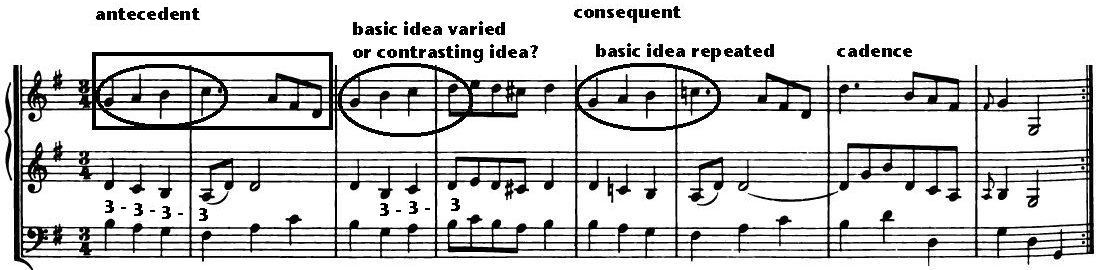
In K. 164, the trio to n6 is one of the periods that might have been read as a presentation-consequent theme:

Here the issue is clearly not bars 5-6, where bars 1-2 are literally repeated, in entirety. The issue is in bars 3-4, where the opening of the figure (bar 3) suggests "basic idea varied" and the end (bar 4) says "contrast." In general, I favor the effect of the opening, but in this case the strong contrast effected by a different direction for the parallel thirds in the accompaniment parts renders bar 5 a clear "return to the beginning" by contrast.

Here is a similar problem with a different result: K164n3, the trio:


Does bar 5 act like the opening of a consequent, rather than, as I have it, a continuation phrase? The "dogged adherence" to a figure would certainly suggest it, but what's lacking here is a sense of returning to the beginning, which a consequent must have. Here the sequence, going down by thirds (D-B-G in the melody), erases any sense of "starting over." If anything, this theme sounds like a six-measure phrase + a cadence.

Saturday, June 11, 2016

Mozart menuets and Caplin's theme types, part 2

This is a follow-up to yesterday's post that provided stats for theme types in the first strains of one early set of menuets (K. 164) and two late ones (K. 568 & 585).

Caplin's seven classes of eight-bar themes are as follows:

  • c1. period 

  • c2. sentence 
  • 
c3. period with modulating consequent 
  • 
c4. hybrid 1 (antecedent + continuation) 
  • 
c5. hybrid 2 (antecedent + cadence) 
  • 
c6. hybrid 3 (compound basic idea + continuation) 

  • c7. hybrid 4 (compound basic idea + consequent) 


These seven classes make up his list of all the eight-bar functional units commonly found in the music of the Vienna School (Haydn, Mozart, Beethoven; to which we could add Schubert). Only three from all possible combinations of the four-bar units are missing:

  • 1. presentation + consequent 
  • 2. presentation + cadential
  • 3. compound basic idea + cadential

I would designate presentation + consequent "hybrid 5" because examples do appear occasionally in dance music (as we saw in K. 164; a number of instances occur in Beethoven's dances, as well). I will add 2 & 3 to the list if I ever find any instances of them in music.

To be honest I think that for dance music those themes whose identity depends on particular harmonic shapes do not have anything like the importance that they can have for larger-scale instrumental concert music. For that reason, I would be content with just four classes:

  • c1. period
  • c2. sentence
  • c3. antecedent + continuation
  • c4. presentation + consequent

Within these, one may find variation in clarity of definition. Evaluating such differences can be useful as an interpretive tool. Here are examples from K. 164. In the trio of n2, we see the "classic" sentence design, where a basic idea is clearly repeated, though varied by transposition, and the continuation is built on fragmentation of the head-motive of the basic idea. A formula cadence then ends.


The menuet proper for n2 lies near the other extreme for the sentence: although the presentation phrase works just as it did in the trio above, the continuation introduces a new idea that holds nearly the same rhythm (without the grace note) but is otherwise strongly contrasting in character and presentation. Again a formula cadence follows.


The design of the menuet in n5 lies somewhere in between. The variation of the basic idea is more radical but is certainly still recognizable, but in the continuation we are offered something that sounds like a new idea -- observe the changed rhythm in bar 5, a small but telling moment in such confined quarters. Yet in retrospect we can recognize bars 5-6 as an informal mirror of bars 3-4. The question of such mirrors is a vexed one -- I am inclined toward viewing these as a separate class, which seems reasonable in that Caplin's theme types are grounded in melodic shapes (to which nuances of harmony are added).


Friday, June 10, 2016

Mozart, 6 Menuets, K. 164

The traditional narrative has the period theme dominating the Classical era (that is, European music roughly 1760-1820) but by the end of that time giving way to the sentence (Schoenberg's term): the preference for symmetry somehow turned to a preference for organic development. By now, we know well that this historical model misrepresents much of the music of this era. It certainly misrepresents music for dance.

My claim is that a variety of thematic types was typical of the 17th century and early 18th, as well, but gradually gave way to the symmetrical design of the period by the 1760s because of the popularity of the contredanse, which was based on music for the gavotte (duple time) and gigue (triple). Through most of the century, however, the menuet was prominent in maintaining one of the earlier theme types, the antecedent-continuation design (one of William Caplin's "hybrids"). The goal of my new research is to gain a better picture of just how thoroughly—and during which decades—this design was important.

Mozart provides a particularly good case study, as he was an avid dancer himself (and therefore knew intimately the requirements and changing fashions of dance), and he was also a prolific composer of music for dancing from an early age into the last year of his life, when he held a position as composer of dance music for the Imperial court.

The six orchestral menuets of K. 164 were composed in 1772. The scoring is for two violin parts and bass, augmented by trumpet and 2 oboes (or, sometimes, a solo flute). The designs for the first strain of each menuet and its trio are listed below.
  • n1: sentence
  • n1, trio: period 
  • n2: sentence 
  • n2, trio: sentence
  • n3: period
  • n3, trio: sentence
  • n4: antecedent-continuation
  • n4, trio: sentence
  • n5: presentation-consequent
  • n5, trio: sentence
  • n6: sentence
  • n6, trio: period
The two striking points are (1) the presence of a presentation-consequent hybrid, which Caplin regarded as too rare to even place among his set of hybrid themes; and (2) the prevalence of sentences: seven out of the twelve themes. So much for the narrative that says the sentence arises with Beethoven. In fact, it would seem to be just common sense that the sentence should be well suited to 18th century motive-driven Italianate models of composition and improvisation.

Here are the stats for K. 568, composed in 1788.
  • n1: sentence
  • n1, trio: period with transposed consequent
  • n2: period with transposed consequent
  • n2, trio: period
  • n3: antecedent-continuation
  • n3, trio: period
  • n4: antecedent-continuation
  • n4, trio: period
  • n5: period
  • n5, trio: period
  • n6: sentence
  • n6, trio: sentence* (with contrasting phrase)
  • n7: antecedent-continuation
  • n7, trio: period
  • n8: antecedent-continuation
  • n8, trio: period
  • n9: sentence
  • n9, trio: antecedent-continuation
  • n10: antecedent-continuation
  • n10, trio: period
  • n11: antecedent-continuation
  • n11, trio: sentence
  • n12: antecedent-continuation
  • n12, trio: period
Eleven of these themes are periods, only five are sentences, but eight are antecedent-continuation hybrids.

Here are the stats for K. 585, composed in 1789.
  • n1: sentence
  • n1, trio: period
  • n2: sentence
  • n2, trio: period
  • n3: antecedent-continuation
  • n3, trio: antecedent-continuation
  • n4: antecedent-continuation
  • n4, trio: antecedent-continuation or sentence with mirror variation of bi
  • n5: period
  • n5, trio: period
  • n6: period
  • n6, trio: period
  • n7: antecedent-continuation
  • n7, trio: sentence with continuous figure (motive)
  • n8: period
  • n8, trio: antecedent-continuation, but similar ci
  • n9: period
  • n9, trio: Period
  • n10: sentence
  • n10, trio: period
  • n11: antecedent-continuation
  • n11, trio: period
  • n12: period
  • n12, trio: period

For periods, n = 13; for sentences, n = 4; for antecedent-continuation hybrids, n = 7.

For the late menuets, then, periods do outnumber any other type, but constitute only about half of the total, with antecedent-continuation hybrids significantly represented and sentences by no means missing.

In the next post, I will discuss some examples of the antecedent-continuation hybrid from these three sets of menuets.

Links updated

I have fixed all broken links in earlier posts. Most of those that needed repair now point to PDF essays published on Texas Scholar Works. My page there: link.

Saturday, April 23, 2016

New series on Praetorius Terpsichore

On my Ascending Cadence Gestures blog, I have started a series of several posts on design and cadences in dances from Michael Praetorius's mammoth collection Terpsichore (1612).  The first post is here: link. A second has also been published and six more posts are coming.

After that, there will be another series on dances from John Playford's English Dancing Master (multiple editions from 1651 to 1728).

Saturday, January 16, 2016

Analyses of Schubert Waltz in A Major, D 779n13: PDF essay link, abstract, keywords

Title: Analyses of Schubert Waltz in A Major, D 779n13

Link: Analyses of Waltz in A Major

Abstract: This article gathers a large number of analyses of a single waltz by Franz Schubert: the anomalous A-major waltz, no. 13 in the Valses sentimentales, D 779. The goal is to make more vivid through examples a critical position that came to the fore in music theory during the course of the 1980s: a contrast between a widely accepted “diversity” standard and the closed, ideologically bound habits of descriptive and interpretative practice associated with classical pc-set analysis and Schenkerian analysis.

Keywords: Lerdahl, Caplin, Hook, Guck, Kielian-Gilbert, Schachter, Justin London, Hasty, Richard Cohn, Meyer, Wallace Berry, Fink, Lochead, Schumann, Ravel, Liszt, proto-background, Edward T. Cone