Thursday, June 30, 2016
More on Mozart K. 164
I have added a post about K. 164 on my blog Ascending Cadence Gestures: link. It can be read as a supplement to my post on this blog: link. The new post concerns rising melodic figures in n4 and its trio.

Tuesday, June 28, 2016
New essay published
I have published Form Functions in Menuets by Beethoven and Others, 1770-1813:
A Contribution to the History of Design for Dance Musics on the Texas Scholar Works platform: link.
Here is the abstract:
A Contribution to the History of Design for Dance Musics on the Texas Scholar Works platform: link.
Here is the abstract:
This article adds further documentation for the claim that dance musics in Europe at the end of the eighteenth century were not dominated by the classical symmetrical period but were in fact written in a variety of thematic types and frequently emphasized contrast between ideas (that is, two-bar units). In order to fine-tune descriptions, the terminology for the second phrase in a theme is expanded beyond consequent and continuation (after William Caplin) to include two new categories: contrast and complement.
In addition to two sets of menuets by Beethoven—WoO7 and WoO10—I look at the late menuets of Mozart (K. 461, K. 463, K. 568, K. 585, K. 599, K. 601, K. 604), early menuets by Schubert (D. 41, D. 89), menuets by Friedrich Schwindl (1778), Settree (an English publisher; 1770s?), and Hummel (1807).
Friday, June 17, 2016
Menuets in the keyboard works of D'Anglebert
Five pieces are labeled "menuet" in Jean-Henri D'Anglebert's Pièces de Clavecin (1689), a collection of original compositions and arrangements of orchestral music by Lully.
As in the menuets from Lully's operas, the first strain of the Menuet de Poitou might be read either as a six-bar presentation (the three-bar basic idea is boxed) or a six-bar period with undivided three-bar phrases. The former fits better with Caplin's system, in which an undivided phrase poses a serious problem (we might be reduced to calling it a "phrase-like unit"). Section B (not shown) does have two plausible continuation phrases, at 8 and 6 bars, respectively. Note also that the left hand in bar 4 (circled) differs from bar 1, something better suited to a varied basic idea than to a consequent phrase.

The examples in today's post come from the notated edition by Steve Wiberg (Due West Publications), part of the Werner Icking Music Collection available on IMSLP and used here thanks to Creative Commons Attribution Share Alike 3.0.
In D'Anglebert's arrangement of a menuet by Lully, a period is formed by an antecedent-consequent pair, both of its phrases making imperfect authentic cadences on the tonic (though with different figures in the bass). The underlying design, then, might as easily be repetition of a "4-bar theme."

Much the same happens in the next menuet, except that the two closes are half cadences. Again, subtle rewriting of the left hand part (circled) weakens a period designation.

The "4-bar theme" problem is also present in the Menuet "Dans nos bois," where the PAC comes at the end of the first phrase and a half cadence at the end of the second, the opposite of the pattern we would expect as soon as about 1720.

Finally, the first menuet in the volume offers a clear antecedent-continuation theme in eight bars. The section is 16 bars, however, and the stronger cadence arrival appears in bar 8, not bar 16.

As in the menuets from Lully's operas, the first strain of the Menuet de Poitou might be read either as a six-bar presentation (the three-bar basic idea is boxed) or a six-bar period with undivided three-bar phrases. The former fits better with Caplin's system, in which an undivided phrase poses a serious problem (we might be reduced to calling it a "phrase-like unit"). Section B (not shown) does have two plausible continuation phrases, at 8 and 6 bars, respectively. Note also that the left hand in bar 4 (circled) differs from bar 1, something better suited to a varied basic idea than to a consequent phrase.

The examples in today's post come from the notated edition by Steve Wiberg (Due West Publications), part of the Werner Icking Music Collection available on IMSLP and used here thanks to Creative Commons Attribution Share Alike 3.0.
In D'Anglebert's arrangement of a menuet by Lully, a period is formed by an antecedent-consequent pair, both of its phrases making imperfect authentic cadences on the tonic (though with different figures in the bass). The underlying design, then, might as easily be repetition of a "4-bar theme."

Much the same happens in the next menuet, except that the two closes are half cadences. Again, subtle rewriting of the left hand part (circled) weakens a period designation.

The "4-bar theme" problem is also present in the Menuet "Dans nos bois," where the PAC comes at the end of the first phrase and a half cadence at the end of the second, the opposite of the pattern we would expect as soon as about 1720.

Finally, the first menuet in the volume offers a clear antecedent-continuation theme in eight bars. The section is 16 bars, however, and the stronger cadence arrival appears in bar 8, not bar 16.

Thursday, June 16, 2016
Lully and Playford
To provide some context for the two previous posts, in which I described the design of menuets from three Lully operas, here is a figure from my PDF essay on dance design (link). This is also Table 1 in my 2006 article on the contredanse and the finales of Haydn and Mozart sonatas and symphonies (link).
A tabulation of design for first strains of music in various editions of Playford's English Dancing Master (all editions after the first: Dancing Master). The first edition was published in 1651, the seventeenth (and last) in 1728.

What I call "4-bar themes" are similar to Lully's first strains that are really phrases, not themes in Caplin's sense. In Playford's first edition, these 4-bar themes predominate (see the second column in the table). Next in line are the sentence and the antecedent-continuation model, confirmation of the importance of both in 17th century music. In the later editions (see the third column), the obvious change is what we might call the rise of the period and a drop in the number of sentences.
Here is one example of a dance whose music starts with a "4-bar theme": Lady Cullen. "Theme" and "section" are the same, if one takes the repeat sign as a section demarcator, in the same way as in almost all later dances. If we include the repeat, then the resulting eight bars (that is, mm. 1-4 twice) are a period (though an awkward one in which the antecedent closes on the tonic). If we regard the entire piece (mm. 1 to 4 + 5 to 8) as a single theme, then it is antecedent-continuation. If we include all repeats (1 to 4 + 1 to 4 + 5 to 8 + 5 to 8), the result is a compound (16-measure) sentence.

"4-bar theme"; antecedent of an antecedent-continuation; (with repeat) period; presentation unit of a 16-measure sentence. Of course, the actual design of Lady Cullen when used for dancing will be this: if L stands for the music, then LLLLLLLL. . . as many times as needed for all to complete the figures (this is a long dance, where the length of the dance depends on the number of people dancing).
All this reminds us (1) that the formal function depends on the level one is considering; (2) that Caplin's model does have an unfortunate repetition of labels at 8-bar and 16-bar levels; (3) that in 17th century music there is a fluid relationship between phrase, section, and theme.
A tabulation of design for first strains of music in various editions of Playford's English Dancing Master (all editions after the first: Dancing Master). The first edition was published in 1651, the seventeenth (and last) in 1728.

What I call "4-bar themes" are similar to Lully's first strains that are really phrases, not themes in Caplin's sense. In Playford's first edition, these 4-bar themes predominate (see the second column in the table). Next in line are the sentence and the antecedent-continuation model, confirmation of the importance of both in 17th century music. In the later editions (see the third column), the obvious change is what we might call the rise of the period and a drop in the number of sentences.
Here is one example of a dance whose music starts with a "4-bar theme": Lady Cullen. "Theme" and "section" are the same, if one takes the repeat sign as a section demarcator, in the same way as in almost all later dances. If we include the repeat, then the resulting eight bars (that is, mm. 1-4 twice) are a period (though an awkward one in which the antecedent closes on the tonic). If we regard the entire piece (mm. 1 to 4 + 5 to 8) as a single theme, then it is antecedent-continuation. If we include all repeats (1 to 4 + 1 to 4 + 5 to 8 + 5 to 8), the result is a compound (16-measure) sentence.

"4-bar theme"; antecedent of an antecedent-continuation; (with repeat) period; presentation unit of a 16-measure sentence. Of course, the actual design of Lady Cullen when used for dancing will be this: if L stands for the music, then LLLLLLLL. . . as many times as needed for all to complete the figures (this is a long dance, where the length of the dance depends on the number of people dancing).
All this reminds us (1) that the formal function depends on the level one is considering; (2) that Caplin's model does have an unfortunate repetition of labels at 8-bar and 16-bar levels; (3) that in 17th century music there is a fluid relationship between phrase, section, and theme.
Tuesday, June 14, 2016
Three menuets from Armide
This continues from yesterday. Form descriptions of Lully menuets from the operas show the fluidity (and uncertainty) of design analysis based on Caplin's model and terminology. We saw in the vocal and instrumental menuets from Atys and Proserpine that the design can appear to be simultaneously a small form and a prolonged theme, and that in the latter case an initial phrase is followed by two continuation phrases. The same things are true in one of the three named menuets from the prologue to Armide (1686).
This is the second menuet in a pair. Note the three-bar basic idea and the overall design as a sentence. In section B, however, the first continuation is 8 bars, which seems quite unreasonable for a phrase, but I see no clear way to parse ideas within it. Perhaps Caplin's "continuation-like unit," used for looser form sections in later Viennese music, would be appropriate here. The second continuation, also, differs from the models in the earlier operas, in that it is a repeat of the first, not aa new phrase.

The first menuet in the pair also repeats the first continuation to form the second. Here an expansion of an underlying 4-bar phrase to six by means of sequences (see bars 19-21) is a plausible explanation and not unlike a design one might find in Haydn or even later composers. The overall design is antecedent-continuation and/or small binary.

The third menuet is simpler: an antecedent with two contrasting ideas is followed by a six-bar continuation that ends with a perfect authentic cadence. This design is a simple, balanced binary form (with repetition of each part).

This is the second menuet in a pair. Note the three-bar basic idea and the overall design as a sentence. In section B, however, the first continuation is 8 bars, which seems quite unreasonable for a phrase, but I see no clear way to parse ideas within it. Perhaps Caplin's "continuation-like unit," used for looser form sections in later Viennese music, would be appropriate here. The second continuation, also, differs from the models in the earlier operas, in that it is a repeat of the first, not aa new phrase.

The first menuet in the pair also repeats the first continuation to form the second. Here an expansion of an underlying 4-bar phrase to six by means of sequences (see bars 19-21) is a plausible explanation and not unlike a design one might find in Haydn or even later composers. The overall design is antecedent-continuation and/or small binary.

The third menuet is simpler: an antecedent with two contrasting ideas is followed by a six-bar continuation that ends with a perfect authentic cadence. This design is a simple, balanced binary form (with repetition of each part).

Monday, June 13, 2016
Menuet designs in three Lully operas
Dance is thoroughly integrated into all of Lully's music, and certainly in the operas. For this project, I am restricting myself to pieces named "menuet" in 19th century editions (which are based on contemporary or early 18th century publications).
A look at these menuets shows how closely Caplin's analysis model and terms fits music of the later 18th and early 19th centuries -- by negative example. When ideas are three bars rather than two and clearly demarcated, there is no problem. Six-bar phrases are common enough in 17th century music, and especially in menuets. [note added on 17 June 2017: Meredith Ellis Little, in the "Menuet" article on Oxford Music Online, comments that three-bar phrases were "characteristic of the branle," the most common group dance before the mid-17th century. Thus, we might assume that Lully's use of it reflects a conservative aspect of his work.] The difficulty arises at the next level, as these six-bar phrases consisting of two three-bar ideas are often treated as the first strain in a small binary form. In the analyses here, I have in most instances understood the entire piece as a prolonged theme. Since the distinction is based on length, however, that is not entirely satisfactory as a method.
Nevertheless, we can learn enough about these pieces to say that an antecedent-continuation design prevails, though often as antecedent-continuation 1-continuation 2.
Thanks to text repetition and rhyme, this sung menuet from Atys (1676) provides the clearest example: a six-bar antecedent followed by two six-bar continuation phrases. Strictly speaking, however, the design is aabc (note that the antecedent phrase is repeated exactly, with the same text), which could lead one to read the whole as a compound sentence, where a+a forms a 12-bar presentation and b+c is a 12-bar continuation. The tension one feels between theme, small form, and compound theme appears to be more acute in the 1680s than it does a century later.


Here is the instrumental menuet that precedes the duo. The opening six bars are clear enough. I didn't mark the phrase on the score, but it is obviously a six-bar presentation with two three-bar ideas. The harder part is the second section. I initially analyzed the design as a continuation phrase with two three-bar ideas expanded to five bars (see my "expansion?" note in mm. 9-10), but this seemed like (literally) stretching things a bit too far. Thus, noting again the tension between form levels, we could construe the entire menuet simultaneously as an antecedent with two continuation phrases, or a small binary form (the repetition of bars 1-6 making the demarcation of A-B clear), or a large sentence consisting of presentation (6 + 6 bars) and continuation (5 + 5 bars).

Here is a menuet from the prologue to Proserpine (1680) that is built the same way. In this instance, I think the division of the continuation phrases into distinct ideas is less certain.

The final example is another menuet from the prologue. Here again, a parsing of the continuation phrases into distinct ideas is not as obvious as one might like.

Tomorrow, three menuets from Armide (1686).
A look at these menuets shows how closely Caplin's analysis model and terms fits music of the later 18th and early 19th centuries -- by negative example. When ideas are three bars rather than two and clearly demarcated, there is no problem. Six-bar phrases are common enough in 17th century music, and especially in menuets. [note added on 17 June 2017: Meredith Ellis Little, in the "Menuet" article on Oxford Music Online, comments that three-bar phrases were "characteristic of the branle," the most common group dance before the mid-17th century. Thus, we might assume that Lully's use of it reflects a conservative aspect of his work.] The difficulty arises at the next level, as these six-bar phrases consisting of two three-bar ideas are often treated as the first strain in a small binary form. In the analyses here, I have in most instances understood the entire piece as a prolonged theme. Since the distinction is based on length, however, that is not entirely satisfactory as a method.
Nevertheless, we can learn enough about these pieces to say that an antecedent-continuation design prevails, though often as antecedent-continuation 1-continuation 2.
Thanks to text repetition and rhyme, this sung menuet from Atys (1676) provides the clearest example: a six-bar antecedent followed by two six-bar continuation phrases. Strictly speaking, however, the design is aabc (note that the antecedent phrase is repeated exactly, with the same text), which could lead one to read the whole as a compound sentence, where a+a forms a 12-bar presentation and b+c is a 12-bar continuation. The tension one feels between theme, small form, and compound theme appears to be more acute in the 1680s than it does a century later.


Here is the instrumental menuet that precedes the duo. The opening six bars are clear enough. I didn't mark the phrase on the score, but it is obviously a six-bar presentation with two three-bar ideas. The harder part is the second section. I initially analyzed the design as a continuation phrase with two three-bar ideas expanded to five bars (see my "expansion?" note in mm. 9-10), but this seemed like (literally) stretching things a bit too far. Thus, noting again the tension between form levels, we could construe the entire menuet simultaneously as an antecedent with two continuation phrases, or a small binary form (the repetition of bars 1-6 making the demarcation of A-B clear), or a large sentence consisting of presentation (6 + 6 bars) and continuation (5 + 5 bars).


The final example is another menuet from the prologue. Here again, a parsing of the continuation phrases into distinct ideas is not as obvious as one might like.

Tomorrow, three menuets from Armide (1686).
Sunday, June 12, 2016
Mozart's menuets and Caplin's theme types, part 3
Ironically, perhaps, the presentation-consequent theme class shares an important characteristic with the sentence. The presentation-consequent theme shows a dogged adherence to one idea, which is heard three times, then followed by a cadence. Here is an example from K. 164, n5:

One might even decide that bars 5-6 are "varied" enough that the second phrase could be called a continuation and the whole a sentence. In my view, however, that would be a failure to recognize obvious things in the music that tell us "bar 5 is like bar 1--hear that?"
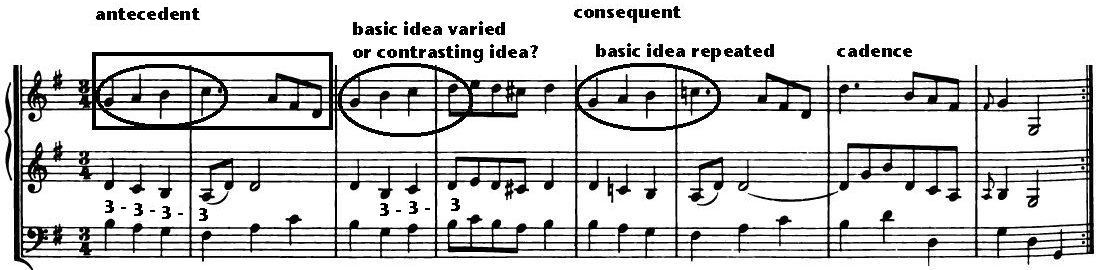
In K. 164, the trio to n6 is one of the periods that might have been read as a presentation-consequent theme:

Here the issue is clearly not bars 5-6, where bars 1-2 are literally repeated, in entirety. The issue is in bars 3-4, where the opening of the figure (bar 3) suggests "basic idea varied" and the end (bar 4) says "contrast." In general, I favor the effect of the opening, but in this case the strong contrast effected by a different direction for the parallel thirds in the accompaniment parts renders bar 5 a clear "return to the beginning" by contrast.
Here is a similar problem with a different result: K164n3, the trio:

Does bar 5 act like the opening of a consequent, rather than, as I have it, a continuation phrase? The "dogged adherence" to a figure would certainly suggest it, but what's lacking here is a sense of returning to the beginning, which a consequent must have. Here the sequence, going down by thirds (D-B-G in the melody), erases any sense of "starting over." If anything, this theme sounds like a six-measure phrase + a cadence.

One might even decide that bars 5-6 are "varied" enough that the second phrase could be called a continuation and the whole a sentence. In my view, however, that would be a failure to recognize obvious things in the music that tell us "bar 5 is like bar 1--hear that?"
In K. 164, the trio to n6 is one of the periods that might have been read as a presentation-consequent theme:
Here is a similar problem with a different result: K164n3, the trio:

Does bar 5 act like the opening of a consequent, rather than, as I have it, a continuation phrase? The "dogged adherence" to a figure would certainly suggest it, but what's lacking here is a sense of returning to the beginning, which a consequent must have. Here the sequence, going down by thirds (D-B-G in the melody), erases any sense of "starting over." If anything, this theme sounds like a six-measure phrase + a cadence.
Subscribe to:
Posts (Atom)