Friday, September 27, 2024

Administrative

This blog is now closed to new content. In a post in March 2014/updated in October 2014, I wrote that in expanding work beyond my original blog,  Hearing Schubert D779n13, posts relating to dance-music designs (that is, musical forms) would be placed here and that the focus would be on William Caplin's form theory and its literature. (Link to Wikipedia article on CaplinLink to Caplin's personal website.)

I have also published several essays on formal designs in music for dance and related music for performance and pedagogy. These are on the Texas ScholarWorks platform. Here are links and descriptions. For information on searching that site by author name, see the end of this post.

Cotillon after Schubert, with audio  (2015)
An episode from a cotillon as Franz Schubert might have played it in the 1820s. UT-Austin doctoral student Josh Straub is the pianist in the audio file.
Dance and Dancing in Schubert's Vienna (2015)
This file has six parts: the first concerns dancing in Vienna and dance music genres during the brief period between the Congress of Vienna and the July Revolution in France (1815-1830). The second part brings the focus ...
Dance Designs in 18th and Early 19th Century Music  (2015)
A study of harmony and formal functions in dance music of the 18th and early 19th centuries. The data and analyses are also intended to supplement the form theory presented in William E. Caplin, Classical Form: A Theory ...
Form Functions in Menuets by Beethoven and Others, 1770-1813  (2016)
This article adds further documentation for the claim that dance musics in Europe at the end of the eighteenth century were not dominated by the classical symmetrical period but were in fact written in a variety of thematic ...
Formal Functions in Menuets by Johann Sebastian Bach  (2017)
The menuet entered into upper-class social dance, ballet, and opera no later than the 1660s, thanks largely to Jean Baptiste Lully. This essay charts formal functions (after Caplin) in named menuets by Johann Sebastian ...
Formal Functions in Menuets by Mozart, Part 1: Orchestral Works and Independent Sets 
A study of formal functions (after Caplin) in named menuets by Mozart, the larger goal being to historicize more fully form-design practices in European music during the second half of the eighteenth century, especially ...
Titles of Parts 2-7:
Part 2: Sonatas and Chamber Music.
Part 3: A Comparison with Johann Christian Bach.
Part 4: His Older Contemporaries, to 1770.
Part 5: More to Theoretical Issues.
Part 6: Contemporaries, 1771-1780.
Part 7: Contemporaries and Successors, 1780-1828. 

-------------------- 

SEARCH FOR MY PUBLICATIONS ON TEXAS SCHOLARWORKS 

Go to this index published in December 2022: post --and this post for additional titles published in 2023-2024: post.     

OR use this link, which goes to the "music" department keyword listing under the Faculty research collection. It so happens that all but 4 entries are mine. Unfortunately, a glitch in the system means that searching by my name now only brings up publications since mid-2022.


Monday, August 13, 2018

Six menuets by Galuppi

While looking for opera buffa files for Baldassare Galuppi, who was as important to that genre in the 18th century as was Offenbach to the operetta in the 19th, I happened on these six menuets, which were included in a 240-page manuscript collection of music for Maria Venier, a resident of Venice. Presumed to be from about 1750, obviously pedagogical in purpose and for the use of a keyboard player, it includes a couple sonatas and sonatinas, a few other pieces, some notation instruction, and many empty pages.

The point of interest here is that the first strain in all six of the menuets is a galant theme, most with a motivically fragmented continuation. I haven't bothered to annotate the scores because the design is identical in all cases.


I found the file on IMSLP, but its original digital source is the Internet Culturale.

Monday, July 9, 2018

New publications: Parts 6 & 7 of the Mozart Form Functions Series

I have published two new essays on Texas Scholar Works. These are the final entries in the series Formal Functions in Menuets by Mozart. Part 6 is subtitled "Contemporaries, 1771-1780"; Part 7 is "Contemporaries and Successors, 1780-1828." Link to Part 6. Link to Part 7.

Here are the abstracts.

Part 6:
This essay continues the documentation of formal functions (after Caplin) in named menuets from the eighteenth century, as begun in parts 1-4 of this series. In this essay, the focus is on menuets written by other composers during the middle decade of Mozart’s life, 1771-1780. The repertoire includes music by Carl and Anton Stamitz, Franz Joseph Haydn, Luigi Boccherini, and several others, as well as menuets in collections or compilations intended for performance, dancing, or pedagogy.

Part 7:
This final essay in the Mozart series charts formal functions (after Caplin) in named menuets written by other composers during the last ten years of Mozart’s life, 1780-1791, and by three composers active in Vienna thereafter, through the death of Schubert (1828). The repertoire includes menuets by Carl and Anton Stamitz, Franz Joseph Haydn, Luigi Boccherini, Giovanni Viotti, and Adalbert Gyrowetz, and several others. The three later composers are Beethoven, Hummel, and Schubert. Concluding comments return to questions of musical form theory.

Thursday, March 15, 2018

Wikipedia article

The Wikipedia article on William Caplin has recently been expanded; it now includes a brief summary of his form function theory and a section with suggestions for "Further reading." Link.

Friday, March 2, 2018

Krähmer, Ländler, op. 8_Note on formal design

As a postscript to yesterday's post on Ländler by Ernest Krähmer, here is the fifth number of his Op. 8, published in 1824.  Score downloaded from IMSLP; modern notation by Hans-Thomas Müller-Schmidt, slightly deformed by me to condense it.


There are three strains, each closed tonally (the first and the third in Eb, the second in Bb). This design is exceedingly common in music meant for dancing; it can be found in published contredanses from the mid-18th century onward, and throughout much of the 19th century it remained the basis of the varying designs for the five numbers of the quadrille.

This design is maximally flexible yet practical. From it one can easily get nearly 2 minutes of music, assuming a bar per second and the most common ABACA realization with all strains repeated (btw, this is the version used in "Pantalon," the first number in the quadrille) . Making it seven parts--ABACABA--offers up to three minutes, plenty for an individual dance (it's used in "Poule," the third part of the quadrille).

I have written about these flexible designs in this blog post: link.
My Schubert blog has a series on forms "with refrains": link; link; link; link; link.

Thursday, March 1, 2018

Krähmer, 12 Ländler

Ernest Krähmer was born near Dresden, educated and began his career in that city, then moved to Vienna, where he was an oboist in the Kärthnertor-Theater and subsequently in the court orchestra. He was also very successful as the primary Csakan virtuoso, an instrument keyed in Ab that became known as the "Romantic recorder" and was very popular during Krähmer's lifetime (he died in 1841) but quickly fell out of favor thereafter. (Information here is translated from the German Wikipedia articles on Krähmer and the Stockflöte. For images of modern reproductions of the instrument, go here: link.)

In my previous post on the Ländler of František Pecháček, I wrote in connection with his 12 Ländler (1801) that they represent the "violinistic Ländler in its traditional form—as distinct from the later keyboard Ländler of Schubert and many other composers in the 1820s, who strive to make the Ländler congenial and specific to the piano, holding to the form and characteristic figures but using less common keys often with chromatic twists and exaggerated registral play, the result being to blur the distinction between music for dance and music for recital."  The Csakan, keyed in Ab, obviously made its own contribution to this shift—indeed, Krähmer and his wife Caroline Schleicher "performed regularly together in Vienna, he on the oboe and the csakan, she on the violin and the clarinet" (translation from the German Wikipedia article on Krähmer).

In the spirit of clarification, however, I remind the reader that the confusion of menuet, Ländler, and Deutscher Tanz [German dance] was at its highest in the first quarter of the 19th century. The dances were still easily distinguishable but the musics for them were not. The music of menuet and German dance had begun to intersect substantively in the 1780s at the latest, as we know from the symphonies and chamber music of Haydn, Mozart, and their contemporaries. In the trios of their menuet movements—especially with Mozart—the distinctive figures of the violinistic Ländler were also sometimes heard, though these can be hard to distinguish from a general pastoral affect. After 1800, things became much worse, a key figure demonstrating that change being Schubert, who is known to have used the label Ländler, Deutscher Tanz, or Walzer in different copies of the same piece. (Publishers were no help in this regard, either.) Walzer was the generic later 18th century term for "turning dances," which included both Ländler and Deutscher Tanz even though their steps, figures, and tempi were quite different. As things stood around 1815, the music of the Ländler was usually quieter and slower than the Deutscher Tanz and preserved more of the traditional figures, where the Deutscher Tanz usually still sounded like the hybrid type of the 1780s. Only in the 1830s, when the tempo of dances generally sped up did the distinction largely disappear and pieces were almost always called Walzer.

All this being said, the first piece in Krähmer's 12 Ländler (published in 1827) is quite obviously a Deutscher Tanz:


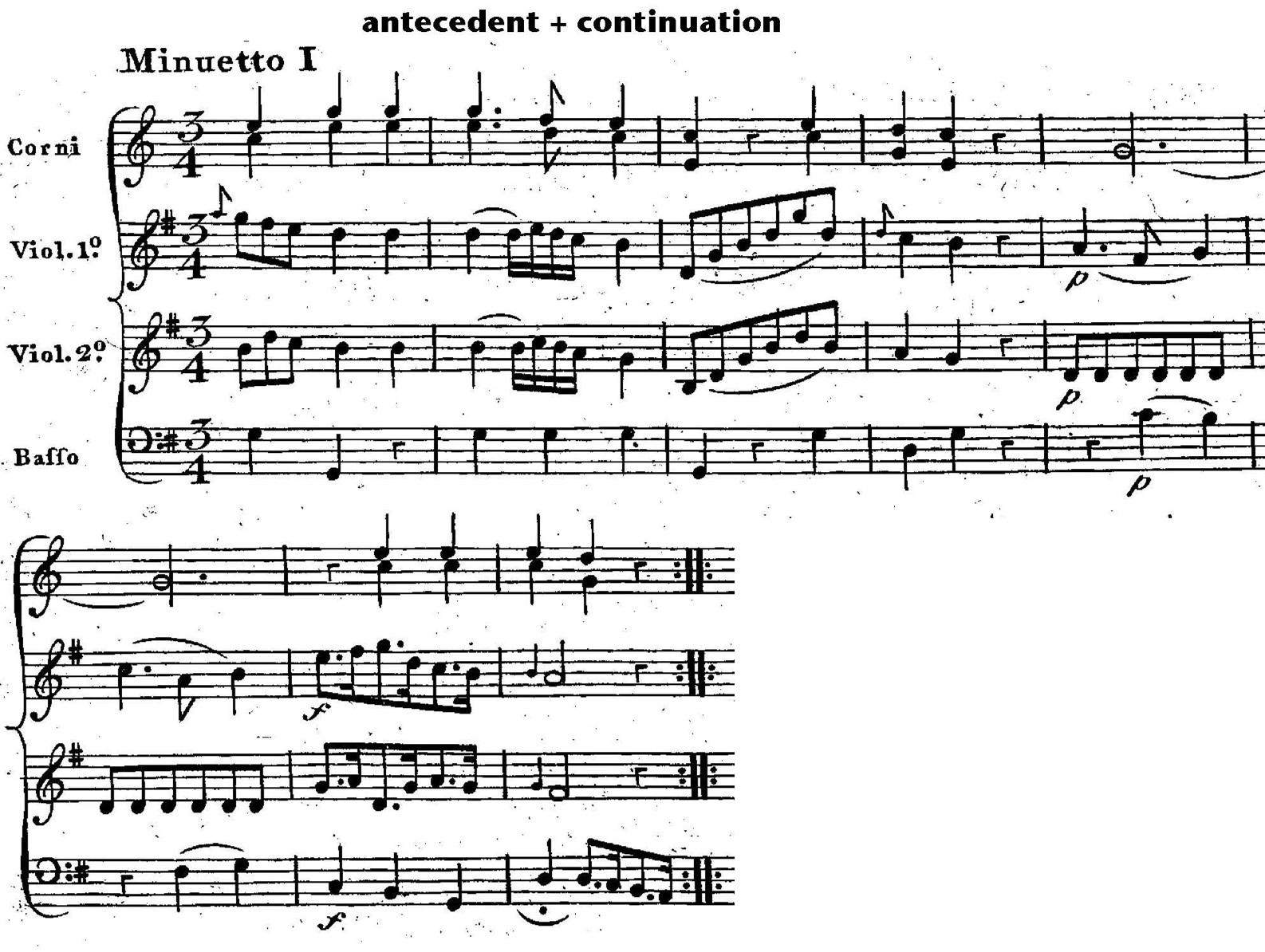
(The modern notation is by Hans-Thomas Müller-Schmidt; downloaded from IMSLP.) Note that the first strain is an antecedent + continuation theme, or what I call the "galant" theme because of its overwhelming importance in the second half of the 18th century: every one of the 2-bar ideas is different. The explanation, perhaps, is that this was intended as a promenade, a regular feature of any extended dance set (Beethoven included one to begin the 12 German Dances, WoO8 (1795), for instance).

The second piece in the set is much more like a Ländler, with soft dynamic, predominantly eighth-note rhythms, and characteristic phrase-ending figures. The chromaticism, however, is distinctive (Schubertian?). The theme is a period.


The third number shows a different side of the Ländler: soft dynamic and phrase-ending clichés but consistent quarter-note rhythms. The B-section would also be familiar to Krähmer's listeners as belonging to rural Ländler practices: the Schnadahüpfel (where the often delicate turning figures of the Ländler are briefly interrupted by loud stomping).


On the Schnadahüpfel, see this post on my Schubert blog: link.
Information on the confusion of waltz-family types draws especially on work by Walburga Litschauer. See these posts on my Schubert blog: link; link; link; link.

Tuesday, February 27, 2018

Pecháček, 12 Ländler (1801)

František Martin Pecháček (1763-1816) was a Bohemian violinist, conductor, and composer who spent his professional career in Vienna as a conductor in the Landstraßer and Kärtnerthor theaters. He was the father of the violin virtuoso Franz Xaver Pecháček.

A prolific composer, Pecháček senior wrote in all contemporary genres, including music for social dance. His 12 Ländler, for an ensemble unusual in the repertoire of the waltz—2 clarinets, 2 horns, and bassoon—were published in 1801.

Like Beethoven's Ländler in WoO11 and WoO15, written at the same time, this set provides an excellent example of the violinistic Ländler in its traditional form—as distinct from the later keyboard Ländler of Schubert and many other composers in the 1820s, who strive to make the Ländler congenial and specific to the piano, holding to the form and characteristic figures but using less common keys often with chromatic twists and exaggerated registral play, the result being to blur the distinction between music for dance and music for recital. A characteristic Pecháček's 12 Ländler do share with later Ländler is their repetitiousness, a marker of their primary role as music for dance, not for performance.

I have reproduced the first clarinet part below, with annotations about themes in the first strains. Of the twelve pieces, the first strains of two are clearly—and two more are probably—presentation + consequent themes, the type with least variation in its units. Five are clearly periods—and two others might be. There is just sufficient difference between basic idea and contrasting idea to identify the opening phrases as antecedents. In the majority of the numbers, the theme's cadential idea is derived from the figure of bars 3-4.

What applies to the first strains also does to the second.


Published parts downloaded from IMSLP.
Wikipedia article on Pecháček: link

Monday, February 5, 2018

A contredanse gigue for the Vestris company

On my Ascending Cadence Gestures blog, I have written a post about a simple contredanse gigue in a collection of dances written by G. B. Noferi for a Vestris family company performing in London; the collection was published in 1781. Link.

Through almost all of the eighteenth century and the first decades of the nineteenth, the two basic types of contredanse music were the gavotte (I wrote about that here: link) in cut time or 2/2 (though after mid-century often in 2/4), and the gigue, written early on in 6/4 but later almost always in 6/8. Strains in published dances were almost always period themes in eight bars -- as in the contredanse gigue in the post linked above.

Here are two additional examples from the Noferi collection. These treat the formal design differently, which would be unlikely in music meant for amateurs but is by no means unusual in numbers for professional dancers. In the first strain of the gavotte, the consequent phrase is transposed and recognizable as a consequent only through the head motive. The second strain combines a contrasting middle (Caplin's term: here a phrase that closes on a half cadence) followed by a reprise of the beginning with a full cadence to end. In every instance, the two-bar units of the gavotte are consistently maintained.


In the gigue, the first strain is a textbook period, the second an equally typical sentence (a two-bar idea followed by a transposed repetition, then by a phrase that breaks up into smaller motives).


Friday, January 19, 2018

New publication: Part 5 of the Mozart Form Functions Series

I have published a new essay on Texas Scholar Works. The title is Formal Functions in Menuets by Mozart, Part 5: More to Theoretical Issues: link. Here is the abstract.
This essay considers some theoretical questions raised at the end of Part 4 in this series. William Caplin’s theory of formal functions in Haydn, Mozart, and Beethoven stipulates that themes are of two primary types (period, sentence) and several secondary types (“hybrids”). These need to be resorted in order to account for eighteenth-century practice more broadly, following from the results of the work in this series, Parts 1-4.

Friday, January 12, 2018

New publication: Part 4 of the Mozart Form Functions Series

I have just published a new essay on Texas Scholar Works: Formal Functions in Menuets by Mozart, Part 4: Older Contemporaries to1770Link.

Here is the abstract:
This essay charts formal functions (after Caplin) in named menuets written during the second half of the eighteenth century. The repertoire includes menuets by Johann Stamitz, Johann Gottfried Müthel, Franz Joseph Haydn, Luigi Boccherini, Maddalena Laura Sirmen, and several other composers, as well as menuets in collections or compilations intended for performance, dancing, or pedagogy.

Friday, January 5, 2018

New publication: Part 3 of Form Functions in Mozart Menuets

I have just published a new essay on Texas Scholar Works: Formal Functions in Menuets by Mozart, Part 3: A Comparison with Johann Christian Bach. Link.

Here is the abstract:
This essay charts formal functions (after Caplin) in named menuets by Johann Christian Bach (1735-1782) and compares them with menuets by Mozart. Bach is notable for exploiting the “galant theme,” presumably because of its ability to emphasize melody and to maximize contrast, in accordance with aesthetic ideals of the galant style.
The repertoire includes, in chronological order, WC 49-54: Concertos, op. 1 (1763); WB 43-48: Trios (keyboard), op. 2 (1763 or earlier); WA 1-6: 6 Sonatas, op. 5 (1765); WB 2-7: Sonatas with violin, op. 10 ; WC 1-6: 6 Symphonies, op. 3 (1765); WC 55-60: Concertos, op. 7 (1770); WB 51-56: String quartets (1770); WB 57: Flute quartets (year?); WB 70-75: 6 Quintets, op. 11 (1772); WC 17b-18b: 3 Symphonies, op. 9 (1773); WZ_6 Trios (Bach, Abel, and Kammel) (1775-76); WC 62-67: Concertos, op. 13 (1777);WA 21: Sonata 2 pianos (1778); WB 10-15 Sonatas (c. 1780); WB 30-35: Trios (1780); WA 7-12: 6 Sonatas, op. 17 (c. 1780); WA 16-20: Sonatas, op. 18 (year?).

Tuesday, November 28, 2017

New publication: Part 2 of Form Functions in Mozart Menuets

I have just published Formal Functions in Menuets by Mozart, Part 2: Sonatas and Chamber Music on the Texas Scholar Works platform.

Here is the abstract:
Continuation of a study of formal functions (after Caplin) in named menuets by Mozart. A table of data and comprehensive musical examples cover the trios, string quartets, string quintets, quartets and quintets with other instrumentation, piano sonatas, and violin sonatas.
For both parts of the study, the principal results are:
(1) An older historical narrative is discredited, according to which 18th century composers used period themes but Beethoven turned toward sentences instead. The menuet designs are remarkably and consistently varied.
(2) The antecedent + continuation theme is so important to the menuet repertoire that I have named it the “galant theme.”
(3) A small but still significant number of presentation + consequent themes appear.
(4) The available theme categories do not account well for some features of an 8-bar theme’s second phrase. In particular, “continuation” is too broad to account for the difference between “development” (as in fragmentation or sequence) and “continuing melody” (as in a new basic idea).

Friday, November 17, 2017

New publication: Form functions in Mozart menuets, Part 1

I have just published Formal Functions in Menuets by Mozart, Part 1: Orchestral Works and Independent Sets on the Texas Scholar works platform: link.

Here is the abstract:
A study of formal functions (after Caplin) in named menuets by Mozart, the larger goal being to historicize more fully form-design practices in European music during the second half of the eighteenth century, especially emphasizing the importance of the “galant theme” or anticipation + continuation/contrast model. The essay includes a table of data along with comprehensive musical examples drawn from the orchestral compositions and from the independent sets of menuets, many of which are either orchestral or keyboard reductions of ensemble pieces.

New publication: Form functions in Bach menuets

I have just published Formal Functions in Menuets by Johann Sebastian Bach on the Texas Scholar works platform: link.

Here is the abstract:
The menuet entered into upper-class social dance, ballet, and opera no later than the 1660s, thanks largely to Jean Baptiste Lully. This essay charts formal functions (after Caplin) in named menuets  by Johann Sebastian Bach, with additional commentary on his contemporaries in Germanophone countries.

Friday, September 1, 2017

New publication: second supplement to British Dance and Song

English, Scotch, and Irish Dance and Song: Supplement 2 was just published on Texas Scholar Works. Here is the link: supplement 2. And here is the abstract:
Another supplement to the essay English, Scotch, and Irish Dance and Song, which is primarily a documentation of rising cadence figures in dances, fiddle tunes, and songs from late eighteenth and early nineteenth century published sources. Gathered here are an additional 70 examples taken from files downloaded in May and June 2017.

Sunday, August 20, 2017

Menuet survey summary

A longer-term goal of the menuet survey—which still needs entries on J. C. Bach and Mozart—has been a large documentation essay to be published eventually, like others, on the Texas Scholar Works platform. At this mid-point in the series of posts (I plan to examine a large number of menuets by Mozart), a summary of the argument might be useful:
This essay historicizes hybrid themes (after Caplin) in terms of first strains in named menuets and (secondarily) first sections in instrumental movements clearly based on the menuet. The antecedent-continuation theme is renamed "galant theme," and—for the purpose of the dance—the list of eight-bar themes is reduced to four: period, sentence, galant theme, and presentation-consequent. This last I sometimes refer to as the "6+2 theme."

Wednesday, July 5, 2017

Menuet series 3-1 (Sacchini)

Antonio Sacchini was a student of Francesco Durante and thus thoroughly trained in the Neapolitan manner we associate now with partimento improvisation, accompaniment, and composition. Sacchini became one of the foremost exponents of the prevailing Italian style across Europe, beginning in Rome, Florence, and Venice (from which he also traveled to Germany), but moving on to London, where he stayed for a decade, and finally to Paris, where Marie Antoinette was his patron. He died in 1786.

 A set of six menuets for string trio and two horns was published in London, presumably during his residence there (between 1772 and 1781).

No. 5. The simplest of periods, where the only change is in the phrase-ending bars (boxed).


No. 4. A classic sentence with an answering transposition in bars 3-4 and fragmentation to start the continuation phrase.


No. 3. Here Sacchini maintains the basic sentence structure but emphasizes contrast rather than developmental continuity. Note the change of dynamic in bar 3 and again in bar 5, as well as the strong contrast in the two ideas of the continuation phrase.


No. 1. Here every idea is different -- what I call a galant theme, with contrast as the expressive goal.


No. 2. Very similar to the preceding.


No. 6


Monday, July 3, 2017

New essay published -- 17th century German and Austrian music

I have published a new essay on Texas Scholar Works: Seventeenth-Century Germany and Austria: Ascending Cadence Gestures. Link.

Here is the abstract:
The seventeenth century in Europe was a particularly rich time for experimentation in musical performance, improvisation, and composition. This essay, meant as an addendum to Ascending Cadence Gestures: A Historical Survey from the 16th to the Early 19th Century (published on Texas Scholar Works, July 2016), documents and analyzes characteristic instances of rising cadential lines in music by composers active in Germanophone countries—and, as it happens, particularly in the cities of Hamburg in the north and Vienna in the south.
Among the composers whose work is discussed are Johann Caspar Kerll, Johann Heinrich Schmelzer, Johann Rosenmüller, Georg Muffat, and Georg Böhm.

Sunday, July 2, 2017

Menuet series 2-13 (Telemann)

Telemann cultivated the galant style in a serious way. His keyboard music and sonatas and fantasies for violin, however, are poor sources for menuets -- many are written in the three-movement design Allegro-Andante-Allegro -- and I turned to the orchestral works for examples. Because that repertoire is very large, I arbitrarily worked with overtures (suites) whose home keys are G or A.

This sentence fits the model quite well. The modern notation, btw, is by Michel Rondeau. I have included only the two clarino parts (identical to violin 1 & 2) and the bass.


This is quite similar to the first example above.


Here is a good example of the galant theme: antecedent + a continuation phrase that contrasts rather than develops.


Here there is less contrast because of the repetition of the basic idea's rhythms.


And here is a case that radicalizes the above. The same rhythms in every bar but the last bring much closer attention to shapes. In such a constrained context, bars 3-4 do sound like a contrasting idea and bars 5-6 like a second contrasting idea. Note that there are some broader connections: the arches showing the same overall direction in each phrase and the motivic ground in the basic idea and in bars 5-6.

Saturday, July 1, 2017

Menuet series 2-12 (Gottlieb Muffat)

Another close contemporary of J. S. Bach, Gottlieb Muffat—who was Georg's son—worked throughout the first half of the 18th century in the Viennese court (among his students was the future Empress Maria Theresa). The six suites in the Componimenti musicali (~1739) contain 13 menuets. Here are comments on several of them.

Suite no. 5, the trio to the second menuet, offers a simple presentation phrase, but the continuation emphasizes contrast, not development. So although I have called it a sentence, this first strain really belongs to a separate category, presentation + contrast, a design that is not only common in the menuet, along with the allied antecedent + contrast, but becomes more and more so in the second half of the 18th century, to the point that it is the preferred form for menuets by J. C. Bach and Mozart.


Suite no. 1, trio to the menuet. Similar to the preceding.


Suite no. 5, second menuet. A "classic" antecedent + continuation theme, with considerable fragmentation in bars 5-7.

Suite no. 6, trio to the menuet. The distinctiveness of the chromatic figure, the placement of the mirror at bar 5, and the extent of the mirroring all favor hearing this theme as a period.


Suite no. 2, menuet. A reasonably straightforward period; the transposition of the basic idea in the consequent is substantial but the arpeggio figure with the rhythms maintained makes the relationship clear.


Suite no. 6, menuet. The formal functions as a "galant theme" make sense. This one is interesting because of the mirroring of rhythms -- see the two (a)s and the two (b)s -- and shapes -- the two (a)s. Despite the mirroring, the continuation phrase is contrasting rather than developmental.

Suite no. 2, trio. Once again the continuation is a contrasting phrase. The presentation is extended by simply adding two bars that transpose bars 3-4 down a third.


Suite no. 6, "menuet III." The previous example hints at a figure realized in this one. I have labeled the formal functions as a sentence, but the effect overall is not 4 + 4 but rather 6 + 2: three statements of an idea followed by a formula cadence with a different melodic figure.


Much the same effect occurs in the 8-bar antecedent of the 16-bar period in J. S. Bach's French Suite in D minor, menuet II. Look especially at the alto voice (arrow).


We will see this 6 + 2 arrangement—and even its reverse, 2 + 6!—in menuets by later composers.