Tuesday, June 20, 2017

Caveats to the preceding

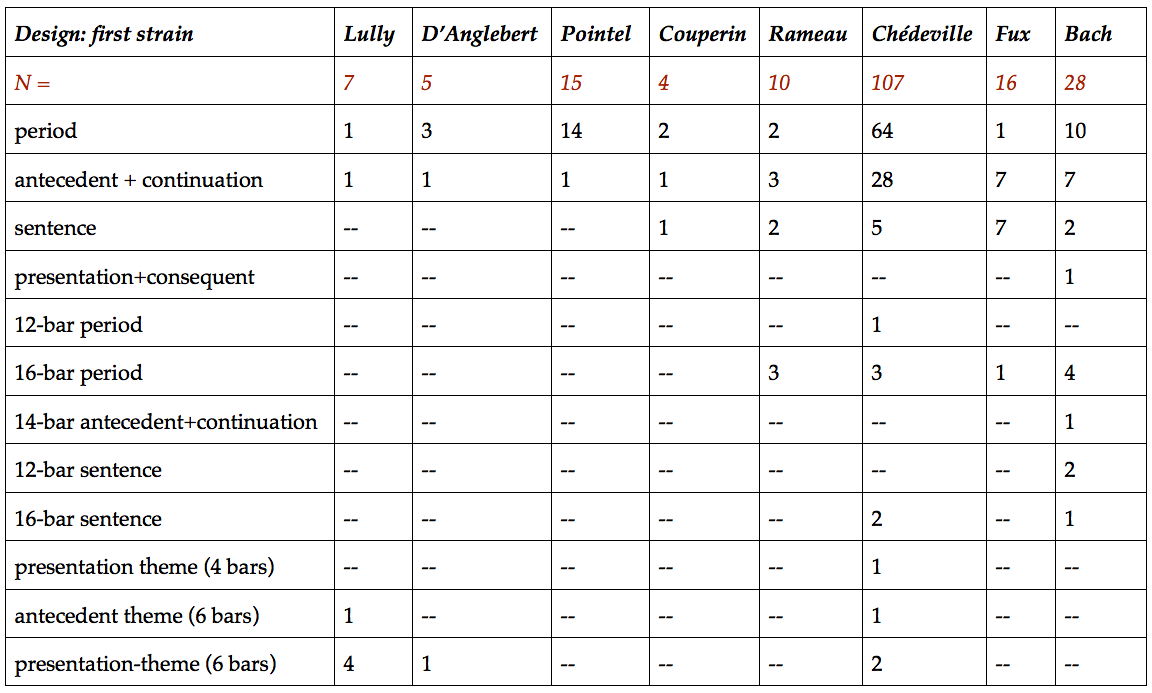
I ended yesterday's post with this table (data on music discussed in this series so far):

After pointing out that this is not a comprehensive picture of menuet history from 1660 to 1730, I mentioned four points of interest. Here are caveats (additional comment) to each:
 (1) The antecedent + continuation theme is the only type other than the period to be found in every sample set, from Lully to Bach. 
The antecedent + continuation theme is not a monolithic type, as I noted in discussion of Fux's menuets. The "classical" version that emphasizes development in the continuation phrase is no more common in the historical era under examination here than is the type that privileges contrast. In their aural and expressive effects, these two types are nearly as distinct as the period and the sentence.
(2) Conversely, the sentence is entirely missing from the early sample sets and is weakly represented still in the later ones (with the exception of Fux). 
Although this generalization works for the repertoire here, it is not a good account of all the social dance and song musics before and including Bach. Sentences are common in music before 1660 (the usual boundary mark for Lully's introduction of the menuet into opera and ballet), as they are also in the collections of Praetorius (1612) and Playford (1651). I think it is fair to say that the sentence is rare in early menuets, and that its introduction into this genre is mostly a later 18th century phenomenon.
(3) Similarly, what Caplin calls "compound themes" are missing in the earlier sample sets but show up clearly in later ones (note 16-bar periods in Rameau, Chedéville, and Bach).
Although expanding themes to greater length is undoubtedly an important rationale for the compound themes, it might also be in part a notational device. Remember that the four-bar theme sounds identical to a period if you include its repeat -- and that four-bar themes were very common in the earlier 17th century. That is to say, a piece with a four-bar theme wasn't necessarily regarded by musicians as just a shorter piece than one with an eight-bar theme. Something similar may well have been true in the early 18th century, when the 16-bar themes begin to appear in some numbers: despite the repeat signs, musicians may also have thought of them as if they were written out variants of an 8-bar theme. (One of the mysteries of early notation in relation to practice is the central repeat sign: did it mark requirement or opportunity? By J. C. Bach's generation, at least, the modern habits seem to have been in place—see the graphic below—but if they were in fact secure in practice, why did Bach go to the trouble of writing out this instruction?) By the end of the 18th century, however, the 16-bar theme was often conceived of in terms of length, as more appropriate to a large instrumental work--the main theme of a concerto movement, for example--than to a small-scale dance. And in those circumstances, of course, there were typically no repeat signs (especially in overture-like symphony or concerto first movements).


Monday, June 19, 2017

Menuet series 2-8: Johann Sebastian Bach

"J.S. Bach’s 28 titled minuets occur in his keyboard partitas and suites, in chamber music for solo and accompanied violin, cello or flute, in three of the four orchestral suites, and in the Brandenburg Concerto no.1" (Little and Jenne, 1991; cited in Meredith Ellis Little, "Minuet," Oxford Music Online).

Here is my version of the list of 28:
1.-2. English Suite No. 4 in F major
3.-4. French Suite No. 1 in D minor
5. French Suite No. 2 in C minor
6.-7. French Suite No. 3 in B minor
8. French Suite No. 6 in E major
9.-10. Partita No. 1 in Bb major
11. Partita No. 4 in D major
12. Partita No. 5 in G major
13.-14. Brandenburg Concerto No. 1
15. Suite in A major for Violin, BWV 1025
16.-17. Suite in Eb major for keyboard, BWV 819
18.-19. Suite in E major for Lute, BWV 1006a
20.-21. Orchestral Suite No. 1 in C major
22.-23. Orchestral Suite No. 4 in D major
24. Orchestral Suite No. 2 in B minor
25.-26. Cello Suite No. 1 in G major
27.-28. Cello Suite No. 2 in D minor
Here are the formal functions in the first strains:
Antecedent + continuation: 7 + 1*
Period: 10
Sentence: 2
Presentation + consequent: 1
12-bar sentence: 2
16-bar period: 4
16-bar sentence: 1
And here is the list again by form function category:
Antecedent + continuation; n = 7
   French Suite No. 1 in D minor, I
   French Suite No. 2 in C minor
   French Suite No. 3 in B minor, II
   Suite in E major for Lute, BWV 1006a, I
   Orchestral Suite No. 4 in D major, II
   Orchestral Suite No. 2 in B minor
   Cello Suite No. 2 in D minor, II
Antecedent + continuation (but A = 36 bars!); n = 1
   Suite in A major for Violin, BWV 1025
Period; n = 10
   English Suite No. 4 in F major, II
   Partita No. 1 in Bb major, II
   Partita No. 4 in D major
   Brandenburg Concerto No. 1, II
   Suite in Eb major for keyboard, BWV 819, I
   Orchestral Suite No. 1 in C major, I
   Orchestral Suite No. 1 in C major, II
   Orchestral Suite No. 4 in D major, I
   Cello Suite No. 1 in G major, I
   Cello Suite No. 2 in D minor, I
Sentence; n = 2
   French Suite No. 6 in E major  
   Suite in Eb major for keyboard, BWV 819, II
Presentation + consequent; n = 1
   Cello Suite No. 1 in G major, II
12-bar sentence; n = 2
   Partita No. 5 in G major  
   Brandenburg Concerto No. 1, I
16-bar period; n = 4
   French Suite No. 1 in D minor, II
   French Suite No. 3 in B minor, I
   Partita No. 1 in Bb major, I
   Suite in E major for Lute, BWV 1006a, II
16-bar sentence; n = 1
   English Suite No. 4 in F major, I
 To establish some context for Bach's menuets, here is a table with data on music discussed in this series so far:

I cannot emphasize too strongly that this is not a comprehensive picture of menuet history from 1660 to 1730. It is more of a snapshot, but in it we can nevertheless see some things of interest. (1) The antecedent + continuation theme is the only type other than the period to be found in every sample set, from Lully to Bach. (2) Conversely, the sentence is entirely missing from the early sample sets and is weakly represented still in the later ones (with the exception of Fux). (3) Similarly, what Caplin calls "compound themes" are missing in the earlier sample sets but show up clearly in later ones (note 16-bar periods in Rameau, Chédeville, and Bach).

In subsequent posts, I will discuss individual menuets by Bach, organizing the posts in terms of formal functions, as above, rather than by source.

Sunday, June 18, 2017

Menuet series 2-7: Fux

Johann Joseph Fux. I looked only to the keyboard works, on the assumption that operas and chamber music such as trio sonatas were unlikely to have examples. I found an independent set of 12 menuets as well as five menuets in the four keyboard suites, one of the latter also being in the set of 12. Thus, N = 16.

The results are definitely an outlier in this study of menuets from 1660 through the 18th century, in the very small number of periods relative to other forms, and in the relatively large number of sentences for menuets in any period, but certainly before 1760. But see my comments on individual pieces below.
period N = 1
antecedent + continuation N = 7
sentence N = 7
16-bar period N = 1
The only period, the rondeau theme in Suite IV, is close to many examples in my recent posts on Chédeville's Recueils and other, earlier menuets. Fux, however, does begin the change in melody in bar 7, not leaving the difference only to the final note.


The statistics given above, however, are clouded a bit by a particular feature that I have seen only occasionally in earlier pieces. Here are examples from the other menuets in the keyboard suites.

The antecedent+continuation theme, in principle, should have the greatest variety of ideas among all the possible eight-bar theme types: in its extreme form, a basic idea is followed by a contrasting idea and then by continuation consisting of a contrasting phrase (a new idea followed by still another shape in the cadence). In the second menuet from the first suite, however, Fux veers to the opposite extreme, where only the narrow confines of 8-10 seconds of music permit us to value contrast over relation in bars 3-4 (the obvious change of harmony helps). I am less comfortable with bars 5-6, which form a complete idea (not fragmentation) that could be heard as a variant of bars 1-2. 


I do believe that antecedent + continuation is the best reading, based on the historical context of the menuet repertoires from Lully onward till the menuet is caught, after the 1730s, in the contredanse's form-leveling influence, which favors the period for all dances. (The height of that influence on the menuet, specifically, was in the 1760s.) Nevertheless, in this menuet from Fux's first keyboard suite, we are, so to speak, at a formal-function crossroads. If I chose to hear bars 5-6 as a variant of the beginning, then the design would be a period. If I chose to hear bars 3-4 as a variant, then the design would be a sentence (if bars 5-6 initiate continuation) or the presentation-consequent hybrid (if bars 5-6 are also a variant of bars 1-2). Any one of the four (underlined) readings is possible. I favor antecedent + continuation, as I said, because of the historical context--but also because of my assertion that small changes count for more in such a small space as the usual first strain in music for social dance. 

I do find the simplicity of Fux's menuets in the keyboard suites a little surprising, more like menuets in the 1680s-1690s than the often highly stylized pieces written by others, such as J. S. Bach, in the 1710s and 1720s. Also, and unexpectedly perhaps, given the mythology that has arisen around Fux because of interpretations of the Gradus exercises, this menuet reminds us yet again of the fragility of our analyses when dance practices are taken into consideration. All it would take is an imaginative (or slightly bored) violinist, playing this strain for the third or fourth time, to turn bars 3-4 into a clearly contrasting idea by changing the rhythms so as not to repeat those of bars 1-2. Similarly for bars 5-6 or for bars 3-4 + 5-6. 

The first menuet is a case in point. I can hear bars 3-4 easily enough as a slightly elaborated transposed repetition of the basic idea, but--again on the small scale of the dance strain--I think contrast wins out. In this case there is no doubt about the continuation phrase, which is sharply different--but that raises the question of whether there should be a distinct theme type, antecedent+contrast. This point was made in several previous posts in this series.


The menuet from suite 3 dramatizes the relation of bars 3-4 to 5-6. There is no question about the status of the first phrase as a presentation, but the sequence spills over into the second phrase, the overall effect being 6 + 2, or sequence + cadence. In fact, although I have called it a sentence, I think that 6 + 2, or (basic idea--variant--variant)--cadence probably would be a better way to describe it.


As I said at the beginning, Fux's menuets are outliers in the general trend of the repertoire during his lifetime. What he does do is hew more closely than some to clarity of definition for the two-bar unit and therefore, paradoxically, he makes his menuets easily danceable. Yet another curiosity.

Friday, June 16, 2017

Menuet series 2-6b: Chédeville l'aîné

Here are a few examples to augment the information from yesterday's post. These four pieces are from the second suite (out of six) in the second volume (out of eight) in Chédeville's Receuils series from the early 1730s. This suite has the following numbers. Dance labels in brackets are my guesses -- they are not part of Chédeville's title.
1. Vaudeville   [gavotte]
2. Menuet
3. Depuis long tems  [rigaudon?]
4. Les Dieux vous ont donné   [menuet?]
5. Parcourez et la terre et londe   [gavotte]
6. Suivons l'Amour dans le bel age   [menuet?]
7. Je suis un bon Soldat  [bourée]
8. Vaudeville  [menuet?]
9. Vaudeville
10. Vous scavéz Climene  [menuet?]
11. La galopade    [gavotte]
12. Menuet
One of the most common of the simple period types, this varies little in the two phrases--eighth notes in bar 4 become a single held note in bar 8 (see circled notes). This is the first menuet in suite 2.


Again a common form: a strongly contrasting second phrase rather than "developmental" continuation. This is from suite 6 in book 2.


A classic sentence. This is the second menuet in suite 2.

A four-bar theme labeled with my term: a presentation phrase that acts formally as a theme. This is from suite 3 in book 2.


Finally, note the variety in the formal functions for the second strains, but all in clearly defined, "tight" designs.
Example 1 above: period
Example 2: 16-bar sentence
Example 3: 16-bar period?
Example 4: period

Thursday, June 15, 2017

Menuet series 2-6: Chédeville l'aîné

Esprit Philippe Chédeville (1696 — 1762) was prominent among French professional musicians in the first half of the 18th century. He was an oboist in the Opéra, later in the King's court, and he became particularly known for his espousal of the musette, or French bagpipes.

In the early 1730s, he began publishing volumes of pieces for the musette, the Recueils de vaudevilles, menuets, contredanses et autres airs choisis pour la musette. (IMSLP link) There are eight volumes in all, with six suites in each, every suite being given four printed pages. The number of individual pieces varies from volume to volume, and I have not attempted a census, but the grand total is probably ~375.

About the motivation for this large undertaking, it appears to be both pedagogical and commercial.
Bruce Haynes' comments in his history of the oboe apply equally to the musette:
It was in this period that publishers discovered a lucrative amateur market. As a consequence, woodwind music generally became less technically demanding than in the previous period, and it was aimed at middle-of-the-road tastes. Some of this "tabloid" music was thus purposely mediocre, and not representative of the best the period had to offer.  (414)
A particularly enthusiastic audience for the musette was aristocratic amateurs following the popularity of the pastoral manner (a cultural phenomenon that was also partly responsible for the prominent place of the gavotte in French contredanses).

Note that Chédeville offered the volumes not just to musette players (see below). Note also that the melodies are supplied with a continuo bass (the basses are figured). In some of the subsequent volumes, the music is written in form of treble duets without bass.


Among the estimated  ~375 pieces in the eight volumes are 107 named menuets, the largest group of named pieces in the Recueils. As in other repertoires discussed recently in this blog, there are undoubtedly more menuets (perhaps as many as 40) but I have excluded them because they were given other titles. I should also note that the number of named gavottes is much smaller--perhaps no more than three dozen--but that, since gavottes were heavily favored as contredanses and contredanses were almost always given special titles--my guess (that is, without making an actual census) is that gavottes rival the menuets in total numbers.

For the named menuets, here is the data for formal functions in the first strain:

period                                 N =  64
antecedent + continuation N = 28
sentence                                 N  = 5
16-bar period                         N = 3
16-bar sentence                 N = 2
presentation-theme (6 bars) N = 2
antecedent theme (6 bars) N = 1
presentation theme (4 bars) N = 1
12-bar period                         N = 1

The obvious points to make are the strong representation of the antecedent + continuation theme and the very low number of sentences. 

Reference: Bruce Haynes, The Eloquent Oboe: A History of the Hautboy 1640-1760. Oxford University Press, 2001.

Wednesday, June 14, 2017

Menuet series 2-5 (Menuets by Rameau)

This sampling of named menuets by Jean Philippe Rameau includes two menuet-trio pairs each from the operas Hippolyte (1733) and Les Indes Galantes (1735), plus one menuet-trio from the keyboard works, for a total of ten pieces. As with Couperin, a substantial number of other pieces in the keyboard works are undoubtedly menuets but are given other, non-dance titles.

For the first strains of each of the ten items:
Hippolyte_menuet 1: sentence
Hippolyte_menuet 1 trio:  antecedent + continuation
Hippolyte_menuet 2: period?
Hippolyte_menuet 2 trio: 16 bar period (8-bar antecedent = antecedent + continuation)
Les_Indes_Galantes-menuet 1: period
Les_Indes_Galantes-menuet 1 trio: antecedent + continuation
Les_Indes_Galantes-menuet 2: sentence with contrasting phrase
Les_Indes_Galantes-menuet 2 trio: antecedent + continuation with HC
Pieces_troisieme_recueil_menuet: 16 bar period (antecedent is antecedent + continuation)
Pieces_troisieme_recueil_menuet trio:  16 bar period (antecedent is antecedent + continuation)
The same information by theme type:
Period:  Les_Indes_Galantes-menuet 1
  Hippolyte_menuet 2
Sentence:   Hippolyte_menuet 1
  Les_Indes_Galantes-menuet 2
Antecedent + continuation:  Hippolyte_menuet 1 trio
  Les_Indes_Galantes-menuet 1 trio
  Les_Indes_Galantes-menuet 2 trio
16-bar period, where 8-bar antecedent = antecedent + continuation:
  Hippolyte_menuet 2 trio
  Pieces_troisieme_recueil_menuet
  Pieces_troisieme_recueil_menuet trio
Here are examples, first strains only, in the order of the list by theme type above. In some of the examples, note the use of the French violin clef.

Period:
Les_Indes_Galantes-menuet 1. A textbook period, except for the ending on V.


Hippolyte_menuet 2. One might be tempted to call this a sentence if one followed the up-and-down meandering of the opening rhythmic figure, but it seems clear that contrast is the goal in the first phrase (note the orchestration) and in any case the upper voice in bars 3-4 is a common melodic cliché of the menuet. Equally, bars 5-6 are meant to recall the beginning, even if the pitches are flipped.


Sentence:
Hippolyte_menuet 1. The continuation is more contrast than development, though one could, I suppose, point to the flipped rhythms (bar 5 = bar 2; bar 6 = bar 1).


Les_Indes_Galantes-menuet 2. The first phrase is very close in design to the first phrase of the preceding example. The second phrase is contrasting, though it does use fragmentation (that is, one-bar elements).

Antecedent + continuation:
Hippolyte_menuet 1 trio. Here again, the continuation is really a contrasting phrase with fragmentation.


Les_Indes_Galantes-menuet 1 trio. The antecedent+continuation theme can achieve maximum contrast, as it does here, in aid of instrumentation and dynamic contrasts.


Les_Indes_Galantes-menuet 2 trio. Every two-bar idea is different.


16-bar period, where 8-bar antecedent = antecedent + continuation:
In all three examples below, the overall period design is very clear. In the eight-bar antecedent, its own antecedent phrase (bars 1-4) is what I call a "weak antecedent" (contrasting ideas but no cadence), or what Caplin calls a "compound basic idea."

Hippolyte_menuet 2 trio.


Pieces_troisieme_recueil_menuet


Pieces_troisieme_recueil_menuet trio

Tuesday, June 13, 2017

Menuet series 2-4: Named menuets by François Couperin

In the thirteen ordres (suites) of keyboard music by François Couperin—as published in the Brahms-Chrysander edition—there are only four named menuets and one passepied (a very close relative). As the list below shows, there is no obvious preference for formal functions in the first strains of the four menuets.

1. Ordre: sentence
2. Ordre: period
3. Ordre: period
9. Ordre: antecedent + continuation

The first menuet may start with an 8-bar sentence but there's little to connect it with the Italian-influenced sentences of Bach, Haydn, or Beethoven. The basic idea is literally repeated, varied only in its ornaments, and the continuation phrase is really a contrasting phrase with no obvious relation to the presentation at all.

 The menuet in the 2. Ordre is much more to formula, a period with IAC in bar 4 and PAC in bar 8.


The third menuet is also a period and also to formula, except that it ends with a HC and is therefore not entirely self-contained.
The fourth menuet is tucked in at the end of the 9. Ordre, after a long series of fancifully named pieces. It is written in 6/8 meter, highly unlikely for the menuet and even for its cousin the passepied, which is typically written in 3/8 time. Here is the opening, which also places the barline oddly.

I have re-barred the piece in 3/8 meter below. Here the sentence form is more familiar sounding, with the repetition of the basic idea in the left hand in bars 3-4, and the bar-length sixteenth note figures that can be heard as stemming from "x" in the second phrase (and even the second ending).


The variety in formal functions in the first strains is, if anything, stressed even more in the second strains, which do at least share the common trait they are all longer than their respective first strains and all use phrase and theme-like units.

1. Ordre, menuet: 16-bar period; non-tonic opening with HC and PAC
2. Ordre, menuet: Contrasting middle with “period 1” (non-tonic opening), the antecedent of which is repeated then a full reprise of A, making the whole a small ternary form. Number of bars in the second strain is 20
3. Ordre, menuet: antecedent (with non-tonic opening) + continuation, repeated. PAC in both cases
9. Ordre, menuet: 16-bar period with two bars inserted between the segments; non-tonic opening with HC and PAC